

Asset location: which investments go in which account


Part 3 of 5
This article is part of our Beyond the basics series.
Short answer: Asset location is about which account holds each investment. Generally: U.S. dividend stocks in an RRSP (treaty exempts the 15% withholding), interest-paying bonds in registered accounts, Canadian dividend stocks and growth equities in a TFSA or non-registered account.
I spent a couple of years holding US dividend stocks in my TFSA before I realized I was paying a tax I didn’t need to pay. Every quarter, when those US companies paid dividends, 15% was being withheld by the IRS before the money even reached my account. Inside an RRSP, that withholding tax doesn’t apply, because of a tax treaty between Canada and the US. But in a TFSA? No treaty protection. The tax just disappears.
It wasn’t a lot of money per quarter. But over years, across thousands of dollars in dividends, it added up. And the fix was simple. I just needed to hold those stocks in a different account.
That’s asset location in a nutshell. Not what you own, but where you own it. And it’s one of those things that often comes up only after you’ve been doing it wrong.
None of this is financial advice. I’m sharing the general framework that most tax-aware investors use, but your specific situation depends on your income, your accounts, and your portfolio. When in doubt, talk to someone who knows your numbers.
Asset allocation vs. asset location
Most investing content focuses on asset allocation. That’s the question of what you own. How much in stocks, how much in bonds, how much in Canadian vs. international, that kind of thing. It’s important, and it’s usually the first decision people make.
Asset location is the next layer. Once you’ve decided what to own, you figure out where to hold each piece. If you have a TFSA, an RRSP, and a non-registered account, the same portfolio can produce very different after-tax results depending on which investments sit in which account.
The goal is straightforward: minimize the tax you pay across your entire portfolio. Different types of investment income are taxed differently, and different accounts have different tax rules. Matching the right investment to the right account is how you keep more of what you earn.
The general framework
Here’s the broad principle most of the tax-efficient investing literature agrees on. It’s not a rigid rule, but it’s a useful starting point.
| Account | Best holdings | Why |
|---|---|---|
| TFSA | High-growth equities, Canadian eligible-dividend stocks, equity ETFs | Everything grows and comes out completely tax-free. The bigger the expected growth, the more valuable the shelter. |
| RRSP | U.S. dividend-paying stocks and U.S.-listed ETFs, bonds, fixed income | The Canada-U.S. treaty waives the 15% withholding tax on U.S. dividends inside an RRSP. Interest is taxed at your full marginal rate outside, so sheltering it matters. |
| Non-registered | Canadian dividend stocks, tax-efficient growth holdings | Canadian dividends benefit from the dividend tax credit; capital gains are only 50% taxable. Interest is fully taxable, so put as little as possible here. |
The intuition behind the table: each account has different tax mechanics, so matching the income type to the account that taxes it least is how you keep more of what you earn.
The withholding tax detail
This is the part that made me rethink my own portfolio.
When a US company pays a dividend, the IRS withholds 15% at the source. If you hold that stock in an RRSP, the Canada-US tax treaty waives that withholding. You get the full dividend. If you hold it in a TFSA or non-registered account, the 15% is withheld.
In a non-registered account, you can at least claim a foreign tax credit on your Canadian tax return to recover some or all of that withholding. In a TFSA, you can’t recover it at all. It’s just gone.
This is why holding US dividend payers in your TFSA is the least efficient option. The TFSA is supposed to be tax-free, but that 15% withholding makes it less than tax-free for US dividends.
If you hold US-listed ETFs that themselves hold US stocks (like VTI or VOO), the withholding happens at the fund level and the same treaty rules apply. If you hold Canadian-listed ETFs that hold US stocks (like VFV or XUU), there’s an additional layer of complexity. We cover the full breakdown in our US dividend withholding tax guide.
When simplicity beats optimization
Here’s the honest caveat. If your total portfolio is under $100,000 or so, the dollar impact of asset location is relatively small. We’re talking about maybe saving $50 to $200 a year in taxes. That’s real money, but it might not justify restructuring your accounts and adding complexity.
If you’re using an all-in-one ETF like XEQT or VGRO, the entire point of that product is simplicity. You hold one fund across all your accounts, and you don’t think about it. Breaking it apart to optimize asset location somewhat defeats the purpose, and for smaller portfolios, the tax savings often don’t outweigh the added hassle.
Where asset location really starts to matter is when your portfolio grows larger, when you have meaningful balances across multiple account types, and when the tax drag from suboptimal placement compounds over decades. For someone with $500,000 across a TFSA, RRSP, and non-registered account, the annual tax savings from proper asset location can run into thousands of dollars.
So if you’re just starting out, don’t let this stop you from investing. Put your money in whatever account makes sense and buy what fits your plan. You can always optimize later as your portfolio grows. If you’re already past that stage and wondering what to do once your registered accounts are full, asset location becomes much more relevant.
The order of priority
If you’re thinking about implementing asset location, here’s a rough order of what to tackle first.
Move US dividend stocks out of your TFSA. This is the single highest-impact change for most people, because the withholding tax in a TFSA is unrecoverable.
Put your highest-growth holdings in your TFSA. This maximizes the tax-free compounding.
Hold bonds and interest-bearing investments in your RRSP. Interest is the most heavily taxed income type, so sheltering it makes sense.
Save Canadian dividend stocks for your non-registered account, where they benefit from the dividend tax credit.
Again, this is a general framework. Your ideal setup depends on the relative size of each account, your marginal tax rate, and how much complexity you’re willing to manage.
Don’t forget about rebalancing
One practical note. If you split different asset classes across different accounts, rebalancing becomes a bit more involved. Instead of just rebalancing within one account, you’re looking at your portfolio across all accounts and figuring out where to buy or sell to get back to your target allocation.
This isn’t hard, but it requires a portfolio-level view rather than an account-level view. You need to see the total picture.
The bottom line
Asset location is one of those invisible optimizations that doesn’t feel exciting but quietly saves you money every year. For smaller portfolios, keep it simple and don’t stress about it. For larger, multi-account portfolios, placing the right investments in the right accounts is one of the most practical tax strategies available to Canadian investors.
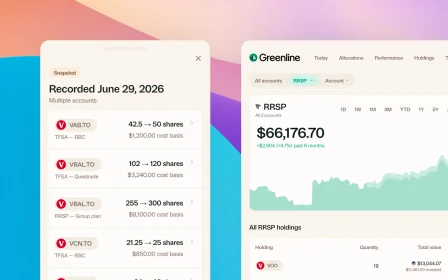
If you’re managing investments across your TFSA, RRSP, and non-registered accounts, Greenline shows you the full portfolio view across all accounts so you can make asset location decisions with the complete picture.
Knowing what a fund holds is the easy part. The harder question is what you actually own across every account, and how it's really doing. It's the sort of thing we built Greenline for, if that'd ever be useful to you.
More in DIY Investing

What to do after maxing your registered accounts

Withholding tax on US dividends in Canada

How dividends work (and get taxed) in Canada

The multi-account problem

The Smith Manoeuvre: making your mortgage tax-deductible
What to do after maxing your registered accounts
You've filled your TFSA, RRSP, and FHSA. Now what? Non-registered accounts, capital gains, tax-loss harvesting, and where to put the overflow.
Withholding tax on US dividends in Canada
How dividends work (and get taxed) in Canada
The multi-account problem