

CAGE vs VEQT: comparing CIBC's new Avantis ETF to Vanguard's all-in-one


Short answer: CAGE.TO is a new factor-tilted all-equity ETF from CIBC and Avantis. VEQT is Vanguard’s long-running cap-weighted all-equity all-in-one. CAGE costs about 6 basis points more (0.28% management fee versus VEQT’s 0.22% MER) and runs a deliberate value, size, and profitability tilt. VEQT is broadly the global market by size, with a slightly more Canada-heavy split than XEQT. On Canada, the two now look alike: both hold about 30%. The choice is factor-tilted active versus cap-weighted indexing, not better versus worse.
If you’re already holding VEQT, you’ve probably made one specific choice: you want one ticker, all equities, and a Canadian-flavoured global tilt. VEQT has been the default for that crowd since 2019. The Vanguard brand carries weight, and the slightly higher Canada allocation appeals to investors who want home bias without thinking about it.
CAGE.TO showed up on the TSX on March 18, 2026, and the question for VEQT holders is straightforward: is this a swap, a complement, or a “no thanks, I’m fine”?
This is not financial advice. I’m sharing what I’ve learned from my own research, and your situation might be different from mine. Fund details change over time, so always check the latest disclosures before making a decision.
What CAGE actually is
CAGE.TO is an all-equity, globally diversified ETF listed on the TSX in March 2026. CIBC manages the Canadian wrapper. Avantis Investors, a unit of American Century, designs and runs the strategy.
It’s structured as a fund-of-funds, holding a basket of underlying Avantis equity ETFs that cover U.S., international developed, emerging, and Canadian stocks. The headline numbers: 100% equities, unhedged, 0.28% management fee. The fund page doesn’t show an MER yet, but CIBC’s first interim report puts it at 0.35% annualized (period ended June 30, 2026).
The thing that makes CAGE different from VEQT is the strategy. CAGE is rules-based active, with a deliberate tilt toward value, smaller, and profitability. VEQT is broadly cap-weighted indexing.
If you want the deeper walkthrough of CAGE on its own, the CAGE ETF explained guide covers structure, holdings, and the factor approach in more detail.
What VEQT is, briefly
VEQT is Vanguard Canada’s all-equity all-in-one ETF, listed in 2019. It’s a cap-weighted fund-of-funds that holds underlying Vanguard index ETFs across U.S., international developed, emerging, and Canadian stocks. The MER is around 0.22%, following Vanguard’s November 2025 fee cut.
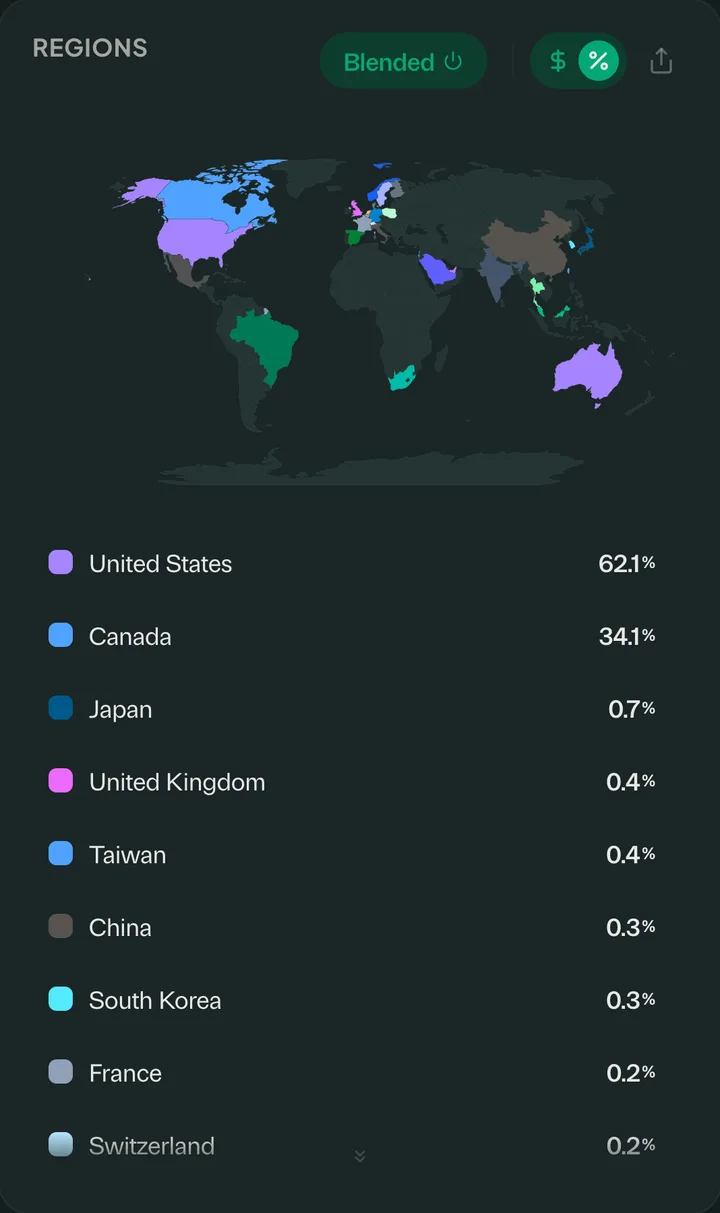
The piece that distinguishes VEQT from XEQT inside the cap-weighted category is the Canada weighting. VEQT’s home-country allocation runs around 30% (29.65% at September 30, 2026), noticeably above XEQT’s roughly 25%. People who hold VEQT tend to like that. It reflects a deliberate Canadian tilt, not an accident. The good news for VEQT holders weighing CAGE: CAGE’s first holdings report showed 29.5% in its Canadian fund at June 30, 2026, essentially the same home weighting.
What “factor tilt” actually means
This is the part that matters. Without it, the comparison doesn’t make sense.
VEQT owns the global stock market roughly in proportion to size. The biggest companies (Apple, Microsoft, Nvidia, and so on) get the biggest weights, with a Canadian overlay that boosts domestic holdings. CAGE owns a similar global universe but applies three deliberate tilts on top of cap weighting:
- Value. Cheaper companies relative to their fundamentals (book value, earnings, cash flow) get more weight than they would in a cap-weighted index.
- Size. Smaller companies get more weight than market cap alone would give them. Not “small-cap only,” just less concentration in the megacaps.
- Profitability. Reliably profitable companies get included or overweighted. Chronically unprofitable ones get filtered out or down-weighted.
The academic case goes back to Eugene Fama and Kenneth French in the early 1990s, with Robert Novy-Marx adding the profitability piece in 2013. Decades of data suggest these factors have rewarded patient investors over very long horizons.
The honest caveat is that “very long” can mean a long time. Factor-tilted portfolios can underperform broad cap-weighted indices for ten years or more at a stretch. Anyone moving from VEQT to CAGE has to be willing to sit through stretches of trailing the cap-weighted version without flinching. That’s a real ask.
CAGE vs VEQT side-by-side
A row by row look. CAGE’s figures come from CIBC’s first interim report (June 30, 2026); VEQT’s from Vanguard’s fund page (September 30, 2026).
| Attribute | CAGE.TO | VEQT.TO |
|---|---|---|
| Manager | CIBC, sub-advised by Avantis Investors | Vanguard Canada |
| Strategy | Rules-based active, factor-tilted | Cap-weighted indexing |
| Holdings approach | Fund-of-funds (underlying Avantis ETFs) | Fund-of-funds (underlying Vanguard index ETFs) |
| Headline cost | 0.28% mgmt fee; 0.35% annualized MER in first interim report | 0.22% MER |
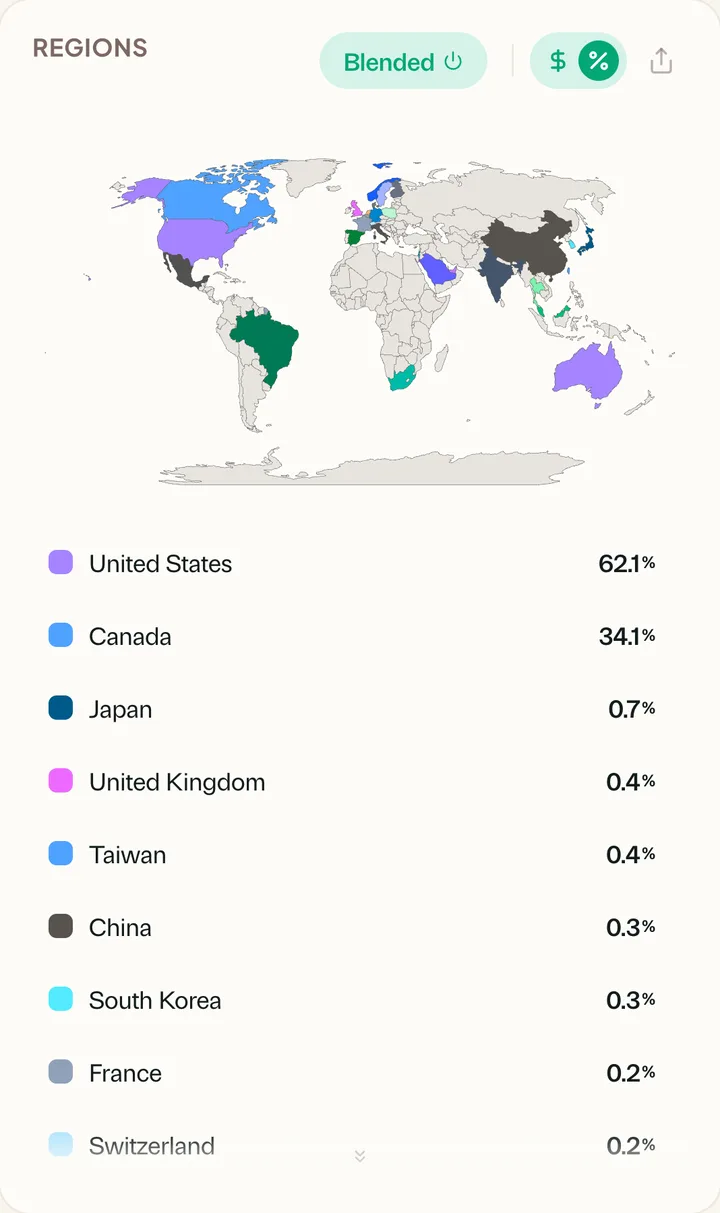
| Geographic split | 41.4% U.S., 29.5% Canada, 16.8% international developed, 7.4% global small cap value, 5.3% emerging | 45.5% U.S., 29.7% Canada, 17.6% international developed, 7.2% emerging |
| Currency hedging | Unhedged | Unhedged |
| Distribution frequency | Quarterly | Annually |
| AUM | About $695M (June 30, 2026) | About $17.5B |
| Track record | Months of data | Listed since 2019 |
| Listed since | March 18, 2026 | January 2019 |
CAGE’s management fee is 0.28% and VEQT’s MER is around 0.22% following Vanguard’s November 2025 fee cut, so the spread is roughly 6 basis points (about $60 a year on a $100,000 portfolio). Using CAGE’s 0.35% interim MER, it’s about 13. That’s a little narrower than the gap to XEQT, whose MER is 0.19%. Still small enough that cost alone probably isn’t the deciding factor. The strategy and track-record questions matter more.
The geographic split is where things get interesting for VEQT holders. VEQT’s Canada weight is deliberately higher than XEQT’s, which is one of the main reasons people choose it. CAGE turns out to make the same call: its first holdings report (June 30, 2026) had 29.5% in Canada, against VEQT’s 29.7%. So swapping VEQT for CAGE keeps your home bias roughly where it is. What changes is how each region is weighted inside, plus a dedicated global small cap value sleeve in CAGE.
How CAGE compares to other options VEQT holders are weighing
A few notes on the adjacent choices that come up in the same conversation.
CAGE vs XEQT. XEQT is BlackRock’s cap-weighted all-equity all-in-one, with a slightly less Canada-heavy split than VEQT. The CAGE versus XEQT decision is the same shape as CAGE versus VEQT (factor-tilted active versus cap-weighted indexing) but the cost gap is wider. The full breakdown is in the CAGE vs XEQT guide.
CAGE vs AVGE. AVGE is the U.S.-listed Avantis all-equity fund and the closest U.S. cousin to CAGE. Same Avantis methodology, different wrapper. CAGE simplifies the wrapper by removing the FX conversion and U.S. tax friction Canadians know well.
CAGE vs CASV. Both are Avantis-Canada products from the March 2026 launch. CASV is the small-cap value sleeve and CAGE is the all-equity composite. They do different jobs. The CAGE vs CASV comparison lays out which one fits which role.
For the broader cap-weighted comparison set, the XEQT vs VEQT vs XGRO guide covers the three established all-in-ones side by side.
What to consider before swapping VEQT for CAGE
Five things worth thinking about, in rough order of how often they bite people.
1. The Canada weighting holds up. VEQT’s higher Canada allocation is a feature for a lot of its holders. CAGE’s first holdings report shows nearly the same Canada weight (29.5% at June 30, 2026), so this one isn’t a reason to stay or go. Recheck it as CIBC publishes newer reports.
2. Tracking error vs the cap-weighted market is the whole point, not a flaw. If you pick CAGE, you’re signing up for stretches where it underperforms VEQT, possibly by a lot. That’s the strategy doing what it’s supposed to do. The risk isn’t the underperformance itself, it’s panic-selling during one of those stretches and crystallizing the loss.
3. CAGE has months of Canadian track record. Avantis has a U.S. history, but the Canadian-listed wrapper is brand new. Distribution patterns, how its Canadian-listed underlying Avantis CIBC funds track their strategies, and how the fund-of-funds layer behaves in practice are still being established.
4. Factor premia are a probability, not a promise. The academic case for value, size, and profitability is strong, but premia can compress, disappear for stretches, or behave differently than the historical data suggests. Factor investing has rewarded patient holders historically, but it hasn’t guaranteed anything.
5. Tax behaviour in non-registered accounts isn’t fully proven yet. In a TFSA or RRSP, this matters less. In a non-registered account, how the fund distributes capital gains, and how foreign withholding tax flows through the underlying funds will only really be clear after a full tax year.
If you’re working through these kinds of considerations, the how to pick ETFs in Canada guide walks through the broader checklist.
Who this might be for
This is observation, not recommendation.
CAGE makes the most sense for VEQT holders who already understand factor investing, have a long horizon (think twenty-plus years), and have a real conviction that paying a few basis points more for a value, size, and profitability tilt is worth the volatility and the multi-year stretches of underperformance. “Real conviction” meaning you can articulate why you believe it, not “I read about Avantis on Reddit last week.”
It also fits people who were holding AVGE in a USD account specifically for the Avantis exposure and want to consolidate into a single CAD-denominated wrapper.
For everyone else holding VEQT, you don’t need to do anything. The launch of a new ETF is not a signal that your current setup is broken. VEQT is doing exactly what it was doing yesterday, including the slightly heavier Canada weight that drew you to it in the first place. The most common mistake when a new product gets attention is to assume you should already be in it. That’s almost never true.
Frequently asked questions
Is CAGE better than VEQT?
Neither is “better” in the abstract. CAGE makes a long-term bet on value, size, and profitability factors. VEQT is the global cap-weighted market with a Canadian tilt. CAGE costs about 6 basis points more in management fee (about 13 using its first interim MER). Whichever fits your investment thesis better is the right one for you.
What is the MER difference between CAGE and VEQT?
CAGE’s management fee is 0.28%. VEQT’s MER is around 0.22%, down from 0.24% after Vanguard cut its management fee in November 2025 and the published figure caught up at the March 2026 fiscal year end. So CAGE costs roughly 6 basis points more, or about $60 a year on a $100,000 portfolio. CAGE’s full MER (which adds operating expenses on top of the management fee) came in at 0.35% annualized in its first interim report (to June 30, 2026), so the all-in gap is closer to 13 basis points for now.
Does CAGE have more Canadian exposure than VEQT?
About the same. VEQT runs a deliberate Canada overweight at roughly 30% of the portfolio (29.7% at September 30, 2026). CAGE held 29.5% in its Canadian equity fund at June 30, 2026. Both are well above Canada’s small share of the global market.
Can I hold both CAGE and VEQT?
Yes, though it’s worth thinking about why. Holding both means you’re taking a partial factor tilt rather than a full one. That can be a reasonable middle ground if you’re not sure how strongly you believe in factor investing, but it also dilutes whichever bet you’re making. A cleaner approach is usually to pick one and size your conviction accordingly.
Can I hold CAGE in a TFSA, RRSP, or FHSA?
Yes. CAGE trades on the TSX in Canadian dollars, so it’s eligible in any standard Canadian registered account: TFSA, RRSP, FHSA, RESP, RDSP, RRIF, and LIRA, as well as in non-registered accounts. As with any equity fund, the account type affects how distributions and capital gains are taxed.
What’s the difference between CAGE and AVGE?
AVGE is Avantis’s U.S.-listed all-equity ETF and the closest U.S. cousin to CAGE. Same Avantis methodology, different wrapper. AVGE trades on a U.S. exchange in USD, with U.S. tax treatment on distributions and the FX friction Canadians know well. CAGE is the Canadian-listed equivalent: same factor approach, CAD-denominated, no currency conversion, simpler tax behaviour for Canadian accounts. One real difference: CAGE holds about 30% Canada, while AVGE has no dedicated Canadian fund.
Bottom line
CAGE and VEQT are both reasonable choices for someone who wants one ticker and all equities. They make different bets. VEQT bets on the cap-weighted global market with a Canadian tilt. CAGE bets that value, smaller, and profitable companies will outperform the cap-weighted market over the long run, with a similar Canadian tilt.
The cost gap is small, the wrapper structure is similar, and both are run by credible managers. The decision really comes down to whether you believe in the factor thesis and can hold through years where it doesn’t work. If yes, CAGE is a reasonable expression of that view. If you’re not sure, VEQT is doing exactly what it was doing yesterday.
See how CAGE fits with everything else you own, across every account. Try a sample portfolio


More in DIY Investing

CAGE ETF: what CAGE.TO is, what it holds, and how it works
CAGE vs XEQT: what to know about Canada's new Avantis all-equity ETF
CAGE vs ZEQT: how the new Avantis ETF stacks up against BMO's all-equity
CAGE vs AVGE: Avantis all-equity, Canadian-built versus U.S.-listed
CAGE vs CASV: complete portfolio versus pure small-cap value tilt

Avantis CIBC ETFs: factor investing arrives in Canada
XEQT vs VEQT vs XGRO: which all-in-one ETF is right for you?
CAGE ETF: what CAGE.TO is, what it holds, and how it works
CAGE.TO is CIBC and Avantis's all-equity ETF, listed on the TSX in March 2026. What it holds, the 0.28% management fee, the factor tilt, and who it's for.
CAGE vs XEQT: what to know about Canada's new Avantis all-equity ETF
CAGE vs ZEQT: how the new Avantis ETF stacks up against BMO's all-equity
CAGE vs AVGE: Avantis all-equity, Canadian-built versus U.S.-listed
CAGE vs CASV: complete portfolio versus pure small-cap value tilt
Avantis CIBC ETFs: factor investing arrives in Canada