


What happens to your investments when you separate or divorce


Short answer: In a Canadian divorce, investment accounts accumulated during the marriage are usually subject to division under provincial family law. RRSPs can be split tax-free using a CRA-recognized rollover; TFSA transfers don’t use up new contribution room. Talk to a family lawyer before signing anything.
Nobody plans for this when they open their first investment account. You pick a TFSA or an RRSP, you start contributing, and you’re thinking about retirement or a house or just building something for the future. Divorce is not on the list.
But if a relationship ends, your investment accounts become part of the conversation. And the rules around how they’re divided are more nuanced than most people expect.
This is a hard topic. If you’re reading this because you’re going through it, I’m sorry. I hope this overview makes at least the financial side a little less confusing.
None of this is financial advice, and it’s definitely not legal advice. Divorce and separation involve provincial family law, tax rules, and often a lot of nuance. Talk to a family lawyer and an accountant. This is just a general overview of how investment accounts are typically handled.
Family law is provincial, and the rules vary
The first thing to understand is that property division in Canada is governed by provincial and territorial law, not federal law. That means the rules about what gets divided, how it’s valued, and what counts as “family property” differ depending on where you live.
Generally, assets accumulated during the marriage are subject to division. Some provinces also include assets accumulated during common-law relationships, but the rules around common-law property rights are far less consistent across the country. In some provinces, common-law partners have limited automatic property rights compared to married couples.
This is one of the biggest reasons you need a family lawyer who practises in your province. The general principles below apply broadly, but the specifics matter.
The date of separation matters
The value of your assets is typically determined as of the date of separation, not the date the divorce is finalized. Since a separation can take months or even years to fully resolve, the difference can be significant, especially if markets move a lot in between.
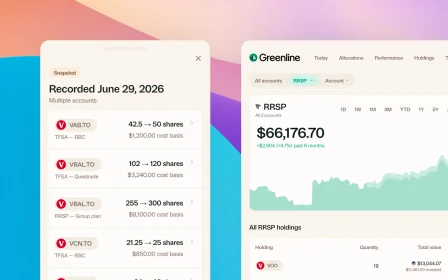
Getting clear documentation of account values as of the separation date is important. This means statements, screenshots, or records from your brokerage showing balances on or near that date. The earlier you do this, the easier it is.
How each account type is divided
The mechanism for splitting investments depends on the account type. The summary below assumes a court order or written separation agreement is in place — without that paperwork, transfers between spouses are treated as ordinary withdrawals or contributions, with all the tax consequences that come with them.
| Account type | How it transfers | Tax at transfer | Future tax burden |
|---|---|---|---|
| RRSP | Direct rollover from one spouse’s RRSP to the other’s under a court order or separation agreement. | None — the CRA allows the transfer tax-free. | The receiving spouse pays income tax when they eventually withdraw the funds in retirement. |
| TFSA | Special transfer between spouses. Doesn’t use up the receiving spouse’s contribution room — they get extra room equal to the amount transferred. | None. | None — TFSA withdrawals stay tax-free. |
| Non-registered | Investments transfer at their original adjusted cost base. | None — capital gains are deferred, not avoided. | The receiving spouse pays capital gains tax when they sell, based on the original ACB. Watch for low-ACB positions with a built-in tax bill. |
| Pensions and RRIFs | Divided per the court order. Defined-benefit pensions may need an actuary to value future benefits. | None for RRIF transfers between spouses. | Income tax on each draw, like a normal RRIF withdrawal. |
The detailed mechanics for each account type follow.
How RRSPs are divided
RRSPs can be transferred between spouses as part of a divorce or separation settlement without triggering tax. This is a big deal, because normally, any withdrawal from an RRSP is taxable income. But when the transfer happens under a court order or written separation agreement, the CRA allows it to move directly from one spouse’s RRSP to the other’s, tax-free.
The receiving spouse takes on the future tax liability. When they eventually withdraw the money in retirement, they’ll pay income tax on it at that point. But no tax is triggered at the time of the transfer itself.
This only works with proper legal documentation. Without a court order or separation agreement, transferring RRSP funds to a former spouse would be treated as a withdrawal by the account holder. That means withholding tax, the full amount added to your income for the year, and permanent loss of that contribution room. The tax consequences of getting this wrong can be severe.
If you had a spousal RRSP, the division follows the same general principle. The account belongs to the annuitant spouse, but the value is still part of the overall family property calculation.
How TFSAs are divided
TFSAs can also be divided as part of a separation, and the rules are actually quite favourable.
When TFSA funds are transferred between spouses under a court order or separation agreement, the transfer doesn’t use up the receiving spouse’s contribution room. Instead, the receiving spouse gets additional contribution room equal to the amount transferred. This is specifically designed so that the division of property doesn’t penalize either party’s TFSA room.
Again, the legal paperwork is essential. A casual transfer between spouses without a court order or separation agreement would be treated as a withdrawal by one spouse and a contribution by the other, which could create over-contribution problems and penalties.
How non-registered accounts are handled
Investments held in non-registered (taxable) accounts can be transferred between spouses at their adjusted cost base (ACB) as part of a separation agreement. This means no capital gains or losses are triggered at the time of the transfer.
The receiving spouse inherits the original ACB. When they eventually sell the investments, they’ll pay capital gains tax based on the difference between the original cost base and the sale price. So the tax isn’t avoided, it’s deferred.
This is worth understanding during negotiations. If you’re receiving investments with a low ACB, there’s a built-in tax bill waiting for you when you sell. That matters when you’re comparing the value of different assets in a settlement.
Pensions and RRIFs
Employer pensions and RRIFs follow similar principles to RRSPs in that they can be divided as part of a separation. But pensions in particular can be more complex, because the value of a defined benefit pension isn’t always straightforward to calculate. You may need an actuary to determine the present value of future pension benefits.
RRIF transfers between spouses on separation work much like RRSP transfers: they can be done tax-free under a court order or separation agreement.
The hidden cost that people miss
One of the most common mistakes in dividing investments is treating all dollars as equal. They’re not.
In a divorce, one of the most common mistakes is treating all investment dollars as equal. A dollar in an RRSP is not the same as a dollar in a TFSA, because one has a tax bill attached and the other doesn’t.
An RRSP worth $100,000 is not the same as a TFSA worth $100,000. The RRSP will be taxed as income when it’s eventually withdrawn. Depending on your tax bracket, the after-tax value might be $60,000 to $75,000. The TFSA comes out tax-free, so it’s worth the full $100,000.
Similarly, a non-registered account worth $100,000 with a cost base of $50,000 has $50,000 in unrealized capital gains embedded in it. That’s a future tax bill.
A fair settlement accounts for these differences. It’s not just about splitting the headline numbers. It’s about splitting the after-tax value. A good accountant can help you and your lawyer think through this properly.
Common mistakes to avoid
Withdrawing from accounts before the separation is finalized. This can trigger unnecessary tax, and courts may look unfavourably on one spouse depleting assets during a separation. If you need access to funds, talk to your lawyer about the right way to handle it.
Not documenting account values early. The longer you wait, the harder it is to establish what things were worth on the date of separation. Get statements from every account as soon as possible.
Forgetting about the tax cost. As mentioned above, not all accounts are worth the same after tax. Make sure your settlement reflects the real, after-tax value of each account, not just the balance on the screen.
Overlooking smaller accounts. It’s easy to focus on the big accounts and forget about a small RRSP at an old employer, a forgotten TFSA, or a non-registered account with a few holdings. Do a thorough inventory. Check old tax returns for contribution receipts if you’re not sure what’s out there.
Get a full inventory early
The single most practical thing you can do, regardless of which side of the process you’re on, is to build a complete list of every investment account, its current value, and the type of account it is. Include RRSPs, TFSAs, non-registered accounts, RESPs, pensions, RRIFs, and anything else.
Note the ACB for non-registered holdings if you can. Note any recent contributions or withdrawals. The more organized this information is upfront, the smoother the process will be for everyone involved.
This is one of those “get professional help” situations
I say “this isn’t financial advice” on every article, but I mean it more here than anywhere else. The intersection of family law, tax law, and investment accounts is complicated. The rules vary by province. The stakes are high. And mistakes can be expensive and, in some cases, irreversible.
A family lawyer who understands financial assets, and an accountant who understands the tax implications of different account types, are not optional here. They’re essential.
A TFSA here, an RRSP there, an FHSA somewhere else. The hard part is seeing them as one picture. Seeing it all in one place is what we built Greenline to do, if you ever want a hand.
More in The Account Maze
TFSA vs RRSP: Which should you max out first?

TFSA contribution room: how it works

RRSP withdrawal rules: what happens when you take money out
TFSA vs RRSP: Which should you max out first?
The classic Canadian investing question. A clear, no-jargon breakdown of when to prioritize your TFSA, when to lean into your RRSP, and why it depends.
TFSA contribution room: how it works