
Asset Allocation
How you divide your portfolio between stocks, bonds, and other types of investments.
Asset allocation is how you split your money across different types of investments. The most common categories are stocks (also called equities) and bonds (also called fixed income). Some people also include cash, real estate, or other alternatives.
A portfolio that’s 80% stocks and 20% bonds will behave differently than one that’s 50/50. More stocks generally means more growth potential but also more ups and downs. More bonds usually means less volatility but lower long-term returns.
How to think about it
Your asset allocation should reflect your situation: how long you plan to invest, how comfortable you are with seeing your portfolio drop in value, and when you’ll need the money. Someone in their twenties saving for retirement has decades to ride out market drops, so a stock-heavy portfolio might make sense. Someone five years from retirement might want more stability.
There’s no single right answer. The popular “all equity” approach works for some people. The traditional 60/40 split works for others. What matters most is that you’ve thought about it and chosen something you can stick with when markets get rough.
Why it matters
Studies have shown that asset allocation is the biggest factor in how your portfolio performs over time. It matters more than which specific stocks or funds you pick. Getting this decision roughly right is more important than getting everything else perfect.
Many all-in-one ETFs (like VGRO, XBAL, or XEQT) handle asset allocation for you by packaging a specific mix of stocks and bonds into a single fund. They rebalance automatically, which means you don’t need to manage the split yourself. Our guide to rebalancing explains how this works and when it matters.
A concrete example
Consider a $100,000 portfolio split 80/20 between stocks and bonds. In a strong year, the stocks might return 12% while the bonds return 3%. Your total return would be about $10,200 (80% of $12,000 plus 20% of $3,000). In a rough year where stocks drop 20%, the bonds might hold steady or gain 4%. Your portfolio would be down about $15,200 instead of a full $20,000. That 20% in bonds cushioned the fall by nearly $5,000.
In Greenline
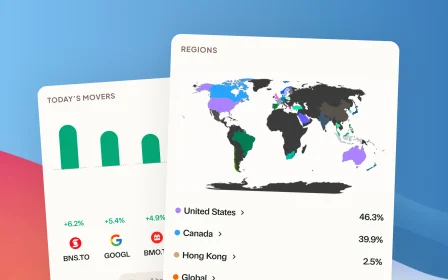
Greenline breaks down your portfolio by geography, sector, and asset class across all your accounts.
Related terms
Index Fund
A fund that tracks a market index like the S&P 500 or S&P/TSX, rather than trying to pick winning stocks.
Exchange-Traded Fund (ETF)
A basket of investments that trades on stock exchanges like a regular stock. Fees and risk vary widely depending on what's inside.
Asset Location
The strategy of placing different investments in specific account types to minimize the tax you pay.


Your money stays where it is. Greenline just makes sense of it.
See all your accounts in one view:
See your full portfolio