We budget our coffees but not our portfolios


Part 6 of 6
This article is part of our Understanding your investments series.
The quick take: Investment fees usually cost more than your coffee habit. A 2% MER on a $200,000 portfolio is $4,000 a year, roughly 14 years of $5-a-day coffee.
A friend of mine tracks every coffee he buys. He has an app for it. He knows that last month he spent $74.50 on lattes, which was $12 more than the month before. He felt bad about it. Adjusted his habits. Started brewing at home twice a week.
That same friend has no idea what he pays in investment fees.
He has a portfolio with over $80,000 in it. When I asked him what his MER was, he said, “My what?” Turns out he’s in a bank mutual fund charging around 2%. That’s $1,600 a year, taken automatically, without a single notification or line item he’d ever notice.
He’s not alone. An Ontario Securities Commission study found that investors scored only 36% on questions about investment costs, the lowest of any category tested. He’s optimizing the $74 and ignoring the $1,600.
The latte math everyone loves
There’s a reason the “latte factor” became a personal finance cliche. It’s satisfying math. Three dollars a day, five days a week, fifty-two weeks a year. That’s $780. Over ten years, invested at 7%, that’s over $11,000. It feels empowering to do that math. You can see the trade-off clearly. Coffee or compound interest.
And it’s not wrong, exactly. Spending adds up. Being intentional about where your money goes is a good thing.
But somewhere along the way, people started confusing “easy to measure” with “most important.” The latte is visible. It’s a choice you make every morning. You hand over the money, you get the cup. It feels like a decision you can control.
Fees don’t feel like anything.
Fund MERs don’t feel like anything. That’s what makes them so sneaky. No transaction, no clear deduction.
The fee math nobody does
The thing about investment fees is this. You don’t pay them. They’re deducted. There’s no transaction, no receipt, no moment where you hand over cash. Your fund just grows a little less than it otherwise would have, and you never know the difference because you never see the counterfactual.
If your portfolio is $100,000 and you’re paying a 2% MER, that’s $2,000 a year. But you won’t find a $2,000 charge on your statement. It’s baked into the fund’s return. You see “up 8%” and think that’s pretty good, not realizing it would have been 10% before fees.
Now stretch that over 25 years. On a $100,000 portfolio growing at 7% before fees, the difference between a 2% MER and a 0.2% MER is roughly $180,000. That’s not a rounding error. That’s a house down payment. That’s years of retirement. And it happened while you were busy feeling guilty about a $5 oat milk latte.
I wrote about how these fees actually work in more detail here, but the short version is: the numbers are designed to look small. 2% sounds like nothing. It’s not nothing.
Why the small stuff feels bigger
There’s a psychological reason for this. Behavioural economists call it the “peanuts effect.” Small, frequent costs feel more real than large, invisible ones. You feel the $5 coffee because you choose it actively, repeatedly, every day. The $2,000 fee is abstract, annual, and automatic. Your brain doesn’t register it the same way.
It’s the same reason people will drive across town to save $10 on a lamp but won’t spend five minutes comparing mortgage rates that could save them $20,000. The lamp savings are concrete and immediate. The mortgage savings are spread over decades and feel hypothetical.
Your portfolio fees are the mortgage version of this problem. They’re big, they matter enormously, and your brain is built to ignore them.
What this actually looks like
Let me make it concrete. Say you invest $500 a month for 25 years. Markets return 7% before fees.
With a 2% MER (typical bank mutual fund), you end up with roughly $270,000.
With a 0.2% MER (a low-cost index ETF), you end up with roughly $370,000.
Same contributions. Same market. A hundred thousand dollars apart. The only difference is a fee that gets deducted automatically, never shows up as a line item, and is easy to overlook entirely.
Meanwhile, you skipped 500 lattes.
The uncomfortable part
Not everyone has the luxury of worrying about either one. If money is tight, the $5 coffee might genuinely be the thing to cut, and the portfolio might not exist yet. I’m not going to pretend that fee optimization matters when you’re trying to cover rent.
But if you do have investments, even modest ones, the fee question deserves at least as much attention as your coffee budget. Probably more.
The irony is that switching from a high-fee fund to a low-fee one is often easier than changing your coffee habit. You don’t have to change your behaviour every morning. You make one decision, maybe move your money from a bank mutual fund to a low-cost ETF, and the savings compound silently for decades.
The real question
It’s not “should I stop buying coffee.” Buy the coffee. Enjoy it.
The real question is: do you know what you’re paying on the money you’ve already invested? Not roughly. Not “I think it’s fine.” Actually know, the way you know what you spent on groceries last month.
If the answer is no, that’s the budget line item worth looking at. Not because small spending doesn’t matter, but because small percentages on large balances matter so much more.
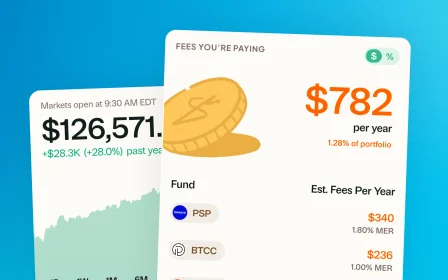
See what you're actually paying in investment fees It's the sort of thing we built Greenline for, if that'd ever be useful to you.
You've reached the end of this series. Back to the overview.
More in The Long Game

What you're actually paying in investment fees

Are ETFs actually better than mutual funds?
Small percentages, big differences
Most millionaires are boring
What you're actually paying in investment fees
Too many investors have no idea what they're paying in fees. MERs, trading commissions, currency conversion. Here's where your money is quietly going.
Are ETFs actually better than mutual funds?
Small percentages, big differences
Why 0.9% and 0.05% look like the same number but aren't. How fees are written in a format designed to look small. The eyes-skip-right-past-them problem.