Do you know what you actually own?

Part 3 of 6
This article is part of our Understanding your investments series.
The quick take: Most Canadian investors can’t say their actual sector or country breakdown without doing math. Diversification by ETF count usually hides real concentration; combining all your accounts into one view is the only way to see what you own.
For a long time, I thought I knew what I owned. I had a TFSA, an RRSP, and a non-registered account across two brokerages. Each one had a handful of holdings. I could name most of them if you asked. But I couldn’t tell you, without pulling up three different apps and a spreadsheet, what my actual asset allocation was. How much was in tech? How much was Canadian? Was I as diversified as I thought?
When I finally sat down and added it all up, I found out roughly 65% of my portfolio was in North American tech companies. Not because I’d chosen that. I’d just bought things that sounded different without realizing how much they overlapped. The S&P 500 ETF was already 30% tech. The “growth” fund was mostly tech with a different label.
I had diversification in name count. Not in actual exposure.
The question most people can’t answer
Try this. Without looking anything up, can you say what percentage of your portfolio is in each sector? How much is Canadian versus American versus international? How much is in stocks versus bonds? How much is in your top five holdings combined?
Most people can’t. And that’s not a criticism. This stuff isn’t obvious. Your brokerage shows you a list of holdings and some green or red numbers, but it doesn’t usually show you the picture underneath. You see the individual pieces. You don’t see what they add up to.
The problem is that “what you own” and “what you think you own” can drift apart without you ever noticing.
How exposure drifts silently
Say you start with a balanced portfolio. Half in a broad Canadian ETF, half in a broad U.S. ETF. That feels diversified, and at the start, it is. But over time, if U.S. stocks outperform Canadian stocks (which they have for a long stretch), the U.S. portion grows and the Canadian portion shrinks. After a few years, your “50/50 split” might be 65/35 without you changing a thing.
This is called drift, and it happens automatically. Your portfolio rebalances itself in the direction of whatever has been winning. Which sounds fine until you realize it’s doing the opposite of what most investing principles suggest. It’s increasing your exposure to what’s already gone up and decreasing your exposure to what hasn’t. Buy high, hold more of it.
If you want to understand how to fix this, I wrote about rebalancing and why it matters. But you can’t fix something you don’t know is happening.
The overlap problem
This is the one that gets people. You buy five different funds thinking you’re spread across five different things. But two of those funds hold the same top 20 stocks. A third overlaps by 60%. Your “diversified” portfolio owns Apple in four different wrappers.
It’s surprisingly easy to end up holding the same companies multiple times without knowing it. An all-in-one ETF like XEQT already holds thousands of stocks across dozens of countries. If you own XEQT and then also buy a separate U.S. index fund, you’re doubling up on every American company. That’s not more diversified. That’s more concentrated.
This isn’t always bad. Maybe you want extra U.S. exposure. The point isn’t that overlap is forbidden. The point is you should know it’s there. The difference between intentional concentration and accidental concentration is just awareness.
In a portfolio, the difference between intentional concentration and accidental concentration is just awareness.
Labels are not descriptions
One of the most misleading things in investing is fund names. “Balanced Growth Fund” could mean almost anything. “Dividend Income Fund” might hold companies that have cut their dividends. “Global Equity Fund” might be 60% American.
Even category labels like “moderate” or “aggressive” don’t tell you much about what’s actually inside. Two “moderate” funds from two different banks can have completely different compositions. One might be 60% bonds. Another might be 40% bonds and 20% real estate. The label gives you a vibe, not a breakdown.
The only way to know what you own is to look at the actual holdings. Not the name, not the category, not the one-line description. The holdings list. What stocks and bonds are in there, in what proportions, and how they overlap with everything else you own.
Why this matters more than you think
If you don’t know what you own, you can’t evaluate whether your returns make sense. You can’t tell if you’re actually up or down relative to what you should expect. You can’t make informed decisions about what to add or remove.
A friend once told me, “I’m pretty conservative, I don’t want too much risk.” His portfolio was 80% equities. He just didn’t know, because the fund names sounded safe and nobody had ever shown him the breakdown.
Another friend thought she was well-diversified internationally because she owned “a global fund.” The fund was 55% U.S. companies. Which is fine if you know it, but she thought she had meaningful exposure to Europe and Asia. She didn’t.
These aren’t mistakes in the traditional sense. Nobody made a bad call. They just didn’t have the information to know what they were actually holding. And without that information, every other investing decision is built on a guess.
What knowing looks like
Knowing what you own doesn’t mean memorizing ticker symbols or checking your portfolio daily. It means, at a basic level, being able to answer a few questions:
What’s my split between stocks and bonds? What countries am I exposed to, and in roughly what proportion? Am I concentrated in any one sector? Do my holdings overlap significantly?
If you can answer those, you’re ahead of most people. If you can’t, it’s worth spending fifteen minutes finding out. Not to make changes necessarily. Just to know. Because the worst version of investing is doing it for years and then discovering your portfolio doesn’t look anything like what you thought.
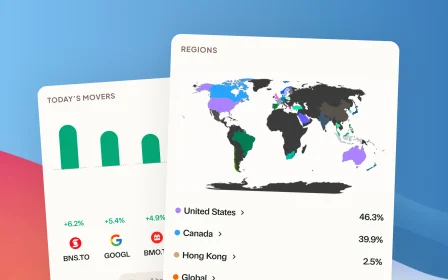
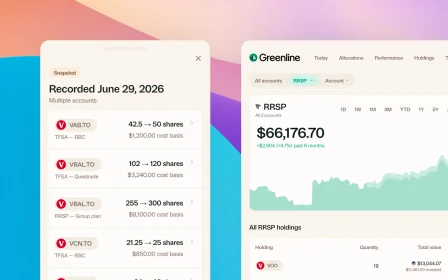
It’s part of why I built Greenline, to show you the breakdown of what you actually own across all your accounts, in one place.
See everything you own across every account, in one place That's the kind of thing Greenline is there for, whenever you want it.
More in The Long Game
Rebalancing: what it means and when to do it

Just buy XEQT? The one-ETF strategy explained

What 'I'm up 3%' really means

The multi-account problem
Rebalancing: what it means and when to do it
Your portfolio drifts over time, and if you never fix it, you might be taking on way more risk than you signed up for.
Just buy XEQT? The one-ETF strategy explained
What 'I'm up 3%' really means
Why headline returns hide more than they reveal. One stock climbing masks another's decline. Fees, dividends, and timing all muddy the picture.