

The multi-account problem


The quick take: When your investments live across multiple accounts and brokerages, no single dashboard shows your full allocation. Spreadsheets work for a while, then drift. The fix is to either consolidate where you can or use a tracker that combines all accounts into one view.
At one point, I had a Tangerine mutual fund account, a TD Direct Investing account, and a couple of other accounts I’d opened along the way. Each one had its own login, its own dashboard, its own little pie chart. None of them talked to each other. I could tell you what was in any single account, but if you asked me “what’s your overall allocation right now, stocks versus bonds, Canadian versus international?” I would have had to pull up three different screens and do math on a napkin.
I built a spreadsheet to solve this. It worked for about six weeks before I stopped updating it. The reality is that when your money lives in multiple places, you lose the full picture. And without the full picture, you’re making decisions based on fragments. Which, over time, ends up being the same thing as making bad decisions.
How it happens
Nobody plans to have accounts everywhere. You don’t sit down one day and think, “I’d like to make my finances as fragmented as possible.”
It happens gradually. You open a TFSA at whatever platform your friend recommended. Your employer sets up a group RRSP at a different institution. Your spouse already has accounts at their own brokerage from before you met. Maybe you opened something at your bank years ago, put $2,000 in it, and haven’t thought about it since.
Each decision made sense at the time. The TFSA at Wealthsimple had no commissions. The employer RRSP came with a match, so obviously you signed up. Your spouse isn’t going to consolidate their accounts just because you prefer a different platform. The old bank account just sort of exists.
Before long, you’ve got three, four, five accounts. None of them wrong. All of them disconnected.
The decisions you can’t make
Here’s where it gets real. When your money is spread across multiple accounts, certain questions become nearly impossible to answer.
Am I too heavy in one sector? Should my next $5,000 go into my TFSA or my RRSP? Am I duplicating holdings across accounts? Is my overall portfolio actually balanced, or does it just look balanced in each individual account?
These aren’t edge-case questions. These are the basic decisions every investor faces. And without the full picture, you’re guessing.
Say you hold XEQT in your TFSA and your spouse holds VEQT in theirs. Those are similar funds, both broad-market, both globally diversified. But your RRSP at the bank has a Canadian equity mutual fund, and your spouse’s RRSP has a “balanced growth” fund that’s heavier on bonds. What does the combined picture actually look like? What’s your household’s real equity-to-bond split? How much Canadian home bias do you have across everything?
You’d need to pull up four different dashboards, look at the underlying holdings of each fund, calculate the weighted percentages, and combine them yourself. Nobody does this. This is not a criticism. I’m saying the infrastructure doesn’t make it easy, so people don’t do it.
The result is that each account gets managed as if it exists in isolation. You rebalance your TFSA without considering what’s in your RRSP. You buy more of the same sectors you’re already overweight in. You might even be paying higher fees in one account for exposure you’re already getting cheaper in another.
The spreadsheet phase
Everyone goes through this phase. I did.
At some point you realize the fragmentation is a problem, so you build a spreadsheet. You pull in all your holdings, list the market values, maybe calculate some percentages. It feels great. You can finally see everything in one place. You feel organized and in control.
It lasts about six weeks.
Then you skip an update. Then another. Then a stock moves 15% and your spreadsheet doesn’t reflect it. Then you add a new position and forget to enter it. Slowly, the spreadsheet becomes less a tool and more an artifact. A snapshot of what you owned at some point in the past. Which is almost worse than no snapshot at all, because you might still glance at it and think it’s current.
The spreadsheet phase teaches you two things. First, that seeing everything together genuinely changes how you think about your money. Second, that maintaining it manually is unsustainable. The value is real but the effort kills it. For more on what’s out there beyond spreadsheets, see the best ways to track your portfolio in Canada.
One portfolio, not five accounts
The mental shift that matters most is this: you don’t have five portfolios. You have one portfolio spread across five accounts.
The accounts are just containers. They have different tax treatments, different contribution limits, different rules. But the money inside them is all working toward the same goal. Your retirement, your financial security, your future.
When you think of each account as a separate portfolio, you optimize each one individually. You might end up with a “balanced” TFSA, a “balanced” RRSP, and a “balanced” non-registered account, each one holding its own mix of stocks and bonds. Three balanced accounts. Sounds fine.
But that’s not actually optimal. Different account types have different tax advantages, and matching the right holdings to the right account type can save you real money over time. You might want to hold your bonds in your RRSP (where the interest income is sheltered), your U.S. dividend payers in your RRSP (to avoid withholding tax), and your growth-oriented equities in your TFSA (where the gains are completely tax-free). This is asset location, and it only works if you’re thinking about your accounts as one connected portfolio.
None of this is financial advice. Your situation, your accounts, your tax bracket, all of it matters. But the principle holds. Thinking in accounts instead of thinking in one portfolio leaves real value on the table.
Seeing the full board
I keep coming back to the chess metaphor. Imagine trying to play a game where you can only see one quarter of the board at a time. You’d make moves that look smart in your visible quadrant but miss threats and opportunities in the parts you can’t see.
That’s what managing fragmented accounts feels like. Each individual account might look fine on its own dashboard. But the whole board, the combined picture across every account, every platform, both spouses, that’s what actually determines whether your financial plan is working.
When my friend finally sat down and combined everything, he discovered his household was 85% equities. Not because either of them chose to be aggressive. Just because each account had drifted slightly in that direction, and nobody had ever looked at the total. He also found he was holding three different funds that all tracked the same U.S. large-cap index. Different wrappers. Same thing inside.
He didn’t need to overhaul everything. He just needed to see it. Once he could see the full board, the adjustments were small and obvious. That’s usually how it goes. The hard part isn’t fixing the problem. The hard part is seeing it clearly enough to know what to fix.
When your investments are spread across multiple accounts, the hard part isn’t fixing your portfolio. The hard part is seeing the full picture clearly enough to know what to fix.
How many investment accounts is too many?
There’s no magic number. Having a TFSA, RRSP, and maybe a non-registered account is normal. Adding a spouse’s accounts is normal. The problem isn’t the count, it’s whether you can see the combined picture. Four accounts that you track as one portfolio is better than two accounts you manage in isolation.
Should I consolidate all my accounts at one brokerage?
It depends. Consolidating simplifies things, and most brokerages will cover your transfer fees. But sometimes there are good reasons to stay split: an employer RRSP with matching contributions, a spouse who prefers a different platform, or different brokerages suiting different needs. The goal isn’t one brokerage. It’s one view of everything you own.
How do I see my overall asset allocation across multiple accounts?
You need to look at the underlying holdings in each account, calculate their combined weight, and add them up. Most people do this in a spreadsheet, at least initially. The important thing is doing it at all. Too many investors optimize each account individually without ever seeing the whole picture.
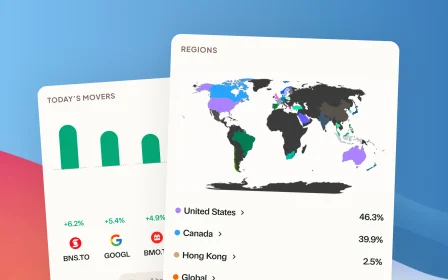
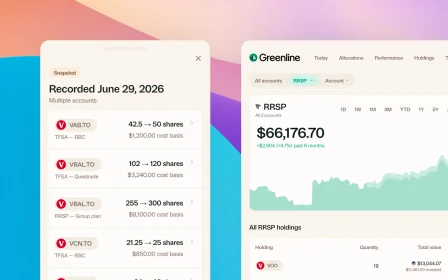
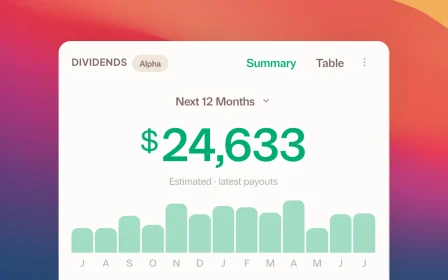
See everything you own across every account, in one place That's the kind of thing Greenline is there for, whenever you want it.
More in The Long Game

Do you know what you actually own?
Asset location: which investments go in which account
How to read your brokerage statement

Best way to track your portfolio in Canada

When to consolidate brokerages (and when not to)
Do you know what you actually own?
Most people can't tell you their portfolio breakdown. Exposure drifts silently. You think you're diversified but you might be 60% tech.
Asset location: which investments go in which account
How to read your brokerage statement
Best way to track your portfolio in Canada