Compound Interest
Earning returns on your returns, so your money grows faster the longer you stay invested.
Compound interest is what happens when your investment earns returns, and then those returns start earning returns of their own. It’s the snowball effect of investing. You start with a small ball of snow, and given enough time, it grows into something much bigger without you having to push harder.
A simple example
Say you invest $5,000 and earn 7% in the first year. That’s $350 in gains, bringing your total to $5,350. The next year, you earn 7% on $5,350, not just the original $5,000. That earns you $374.50. The year after that, you earn 7% on $5,724.50. Each year, the base gets a little bigger, and the growth accelerates.
After 10 years, that $5,000 becomes roughly $9,836 without adding another dollar. After 25 years, it’s over $27,000.
Why it matters
Compounding rewards patience. The longer your money stays invested, the more powerful the effect becomes. The early years feel slow because the gains are small in dollar terms. But over decades, the growth curve steepens dramatically.
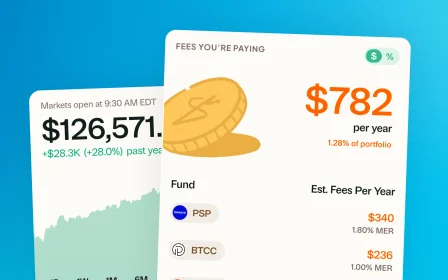
This is also why fees matter so much. A fund charging 2% per year isn’t just taking 2% of your money. It’s taking 2% that would have compounded for you over the years. The real cost of high fees isn’t what you pay today. It’s what that money would have grown into. Our guide on how small percentages make big differences shows exactly how this adds up.
The best thing compounding has going for it is time. You can’t fast-forward it, but you can start.

Your money stays where it is. Greenline just makes sense of it.
See all your accounts in one view:
See your full portfolio