Small percentages, big differences


The quick take: A 0.85% MER and a 0.05% MER look similar but aren’t. On a $200,000 portfolio, that’s $1,700 a year, or tens of thousands over 20 years with compounding. Fees are written as percentages because they’re smaller-looking that way.
When I first moved $5,000 into a Tangerine mutual fund, I didn’t look at the fee. I looked at the return. A few months later I’d made $520 and thought I was a genius. It wasn’t until later that I learned Tangerine’s funds, which were considered cheap at the time, charged around 1.07%. A basic index ETF tracking the same thing cost 0.05%. On $5,000 the difference is small. On $100,000 over 20 years, it’s a second car.
Nobody told me to look at fees as a dollar amount. They were always shown as percentages, two tiny numbers next to each other on a page, easy to skim past.
This isn’t an accident.
The format is the trick
Percentages are inherently deceptive when the numbers are small. Our brains process them relative to the whole number they’re closest to. 0.9% feels close to 0%. So does 0.05%. Both feel like “basically zero.” The difference between them doesn’t register because neither number feels like it matters on its own.
But translate those percentages into dollars on a real portfolio, and the illusion breaks. On $200,000, the difference between 0.9% and 0.05% is $1,700 every single year. Over 20 years with compounding, you’re looking at tens of thousands of dollars.
The financial industry knows this. Fees are always expressed as percentages, never as dollar amounts. You’ll see “MER: 0.85%” on a fund page but you won’t see “This fund will cost you $850 per year on a $100,000 investment, rising as your balance grows.” The first version looks harmless. The second makes you pause.
I wrote a full breakdown of where fees hide and how they stack up here. But the core problem isn’t understanding what an MER is. It’s that the way fees are displayed is designed to make your eyes skip right past them.
The eyes-skip-past-them problem
Think about the last time you looked at a fund’s details. Maybe on your brokerage, maybe on a fund company’s website. Somewhere in that list of information, there was a fee number. A small percentage. Did you stop and do math on it? Did you multiply it by your portfolio balance? Did you compare it to what a different fund charges?
Almost nobody does. An Ontario Securities Commission study found that investors scored only 36% on questions about investment costs, the lowest of any category tested. Not because people are bad at math, but because 0.20% just doesn’t look like a number worth worrying about. Your brain files it under “fine” and moves on.
Now imagine you’re comparing two funds. One charges 0.20% and the other charges 1.98%. If those numbers were $200 and $1,980, you’d never confuse them. That’s a tenfold difference. But written as percentages, both under 2%, they feel like variations on the same small thing.
This is especially true when the numbers all start with zero. 0.03% versus 0.25% versus 0.85%. They’re all “zero point something.” Your brain groups them together. In reality, 0.85% is more than 28 times larger than 0.03%.
Why compounding makes it worse
Fees don’t just take a slice of your money once. They take a slice of your money every year, including the money you would have earned on the slice they took last year. It’s compounding in reverse.
Let’s say you invest $100,000 for 25 years at a 7% market return before fees.
At 0.05% in fees, you end up with about $542,000.
At 0.9% in fees, you end up with about $449,000.
At 2.0% in fees, you end up with about $339,000.
Same starting amount. Same market. The only variable is a number most people can’t be bothered to look up. The gap between the cheapest and most expensive option is over $200,000. That money didn’t disappear into the market. It went to the fund company, one invisible percentage at a time.
The comparison trap
People sometimes tell me, “I compared funds and the fees are pretty similar.” When I ask what they compared, it’s usually two funds from the same bank. One charges 1.8%, the other charges 2.1%. And sure, among bank mutual funds, those are similar.
But compare that 1.8% fund to a broad index ETF at 0.20%, and suddenly you’re looking at a ninefold difference. The comparison only felt close because the frame of reference was wrong. It’s like comparing two expensive restaurants and concluding that dining out is always $80 per person, while ignoring that a different restaurant across the street charges $9.
If you’re comparing fees, compare across categories. Look at what the lowest-cost option charges for the same type of exposure. The spread is often shocking. This is part of what makes the ETF vs. mutual fund conversation so important. The vehicle matters less than the cost inside it.
How to actually see the difference
Whenever you look at a fee, do one thing: multiply it by your portfolio balance. Don’t leave it as a percentage. Turn it into a dollar amount.
0.20% on $50,000 = $100 per year. 1.80% on $50,000 = $900 per year.
Now it’s not “zero point something versus one point something.” It’s a hundred dollars versus nine hundred dollars. That’s a real difference you can feel.
Better yet, project it forward. If you’re investing for 20 or 30 years, the compounding effect turns that annual gap into something enormous. Not because any single year is catastrophic, but because every year the fee chips away at your base, and next year’s growth is calculated on a smaller number.
The thing nobody warns you about
When I first invested, fees weren’t on my radar at all. I bought Tangerine mutual funds and was thrilled to see my money growing. Nobody mentioned fees, and even if they had, I wouldn’t have known whether 1% was good or bad. I had no frame of reference.
That’s the real problem. It’s not that people are ignoring fees. It’s that the way fees are presented gives you no frame of reference at all. A small percentage next to other small percentages, with no dollar translation, no benchmark, no indication of what “good” looks like. You can’t budget what you can’t see. And you can’t see what’s been deliberately made invisible.
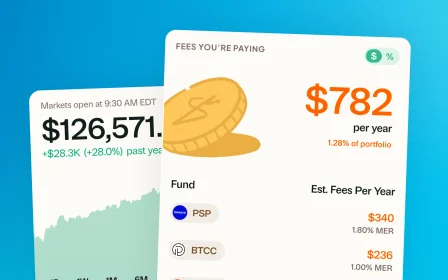
It’s one of the reasons Greenline shows your fees as actual dollar amounts, not just percentages.
More in The Long Game
What you're actually paying in investment fees

Are ETFs actually better than mutual funds?

We budget our coffees but not our portfolios
Do you know how your portfolio is actually doing?
What you're actually paying in investment fees
Too many investors have no idea what they're paying in fees. MERs, trading commissions, currency conversion. Here's where your money is quietly going.
Are ETFs actually better than mutual funds?
We budget our coffees but not our portfolios
People track small spending obsessively but ignore the financial decisions that actually matter. The latte math everyone does vs. the fee math nobody does.