Investing in your 20s in Canada: what I wish I'd known


Part 5 of 7
This article is part of our Getting started right series.
The quick take: Investing in your 20s in Canada matters less for the size of contributions and more for getting started. Open a TFSA, set up an automatic monthly contribution into a low-fee ETF, and let compounding do the work for the next 30+ years.
When I was in high school, I told my family to buy Apple stock. And Lululemon. I was paying attention, doing the reading, following the companies. This was the iPod Mini era, and I was already convinced Apple was going to take over everything. And Lululemon, I remember reading that all of Hollywood was starting to wear it. I genuinely believed in both. But I didn’t have a brokerage account, wasn’t old enough to open one on my own, and didn’t have the confidence to ask someone to help me actually put money behind the call. I had analysis confidence without action confidence. I could see it, but I couldn’t do it.
I started investing at 22. By most standards, that’s early. I still beat myself up about those four missed years. Between 2007 and 2011, the market went through a crash and a recovery. If I’d started at 18, even with small amounts, I’d have bought through one of the best buying opportunities of my generation. I think about that more than I should.
None of this is financial advice. This is just what I wish someone had told me when I was sitting on every paycheque in a chequing account, wondering where else money could possibly go.
Nobody taught me this
I grew up in an immigrant family. My parents worked hard, saved when they could, and never talked about investing. Not because they didn’t care, but because nobody had ever taught them either. Personal finance wasn’t part of their world, and it wasn’t part of mine.
School didn’t help. Not high school, not university. I graduated without knowing what an RRSP was, what compound interest meant, or that there was a difference between a savings account and an investment account. Friends in high school thought I’d end up as a stockbroker. None of us actually knew what that meant.
For a long time, I thought investing was something you did after getting rich. Like it was a reward for having money, not the tool for building it. That misconception probably cost me more than any bad investment ever could.
I thought investing was something you did after getting rich. Like it was a reward for having money, not the tool for building it.
The chequing account years
When I started earning money, I deposited every paycheque into chequing. That’s it. That was my financial plan. I didn’t even use the ATM for deposits because I was too cautious. I’d wait in line to hand the cheque to a teller.
One day, a teller I’d never met stopped me. She looked at my account and asked why I kept everything in chequing. I said, “Where else do I put it?” She listed options I’d never heard of: high interest savings, GICs, mutual funds, self-directed investing. Anything. She said it gently, but the point landed.
That one conversation, from a stranger, changed the direction of my finances. Nobody at home had said it. No teacher had said it. A bank teller did.
The $520 that changed everything
After that conversation, I spent months reading. I moved $5,000 into Tangerine, which offered low-cost mutual funds with no minimum account size. It felt like a big deal. It was most of my savings.
A few months later, I logged in and saw $5,520. I had to double-check. Did I invest $5,000 or $5,500? I went back through my records. It was $5,000. That $520 was just growth. Money I’d earned by doing absolutely nothing.
I had never made $520 of “free money” in my life. It wasn’t a lot, but it was real, and it made the abstract concept of investing click in a way that no article or textbook ever had. I understood, viscerally, that money could work for you. That was the turning point.
Why your 20s matter more than any other decade
Compound interest is the reason. And not in the vague “start early” way that everyone says. In a specific, mathematical way that has real consequences.
If you invest $200 a month starting at 22, and your investments grow at 7% per year on average, you’ll have roughly $440,000 by age 60. If you wait until 30 to start, same amount, same return, you’ll have about $244,000. That eight-year delay doesn’t cost you eight years of contributions. It costs you nearly half your ending balance. The early dollars do the most work because they have the most time in the market.
I see teenagers now investing at 14 or 16 under a parent’s account. The head start they’ll have is staggering. I try not to think about it too much.
The barriers that actually stop young Canadians
Not everyone in their 20s can afford to invest. If you’re paying down student debt, covering rent that takes up most of your paycheque, or just trying to keep the lights on, investing is not the priority. Survival comes first. Anyone who tells you otherwise has never lived paycheque to paycheque. That’s real, and it should be acknowledged.
But for those who do have even a little bit of room, the thing that usually stops them isn’t money. It’s uncertainty. Not knowing where to start. Not knowing how much you need. Feeling like you’ll do it wrong. The shame of not knowing something everyone else seems to already understand.
I talk to people all the time who know their personal finances aren’t in order but don’t know where to go. There’s a real embarrassment factor. Some haven’t even told their partners. The stigma around financial illiteracy is as big a barrier as the illiteracy itself.
What I’d tell my 18-year-old self
Open a TFSA. You get contribution room starting at 18. It’s the most flexible account in Canada, and everything that grows inside it is completely tax-free.
Buy one ETF. Don’t overthink it. A single all-in-one ETF gives you global diversification in a single purchase. You don’t need to research 50 companies or build a complex portfolio. Just start.
Automate it. Set up a recurring contribution. Even $50 a month. The amount almost doesn’t matter at the beginning. What matters is the habit. Once you’re contributing automatically, you stop thinking about it, and the money starts compounding. You can learn about how much you actually need to get started later. The point is to begin.
Stop waiting for the “right time.” There is no right time. The market could go up tomorrow. It could go down. Over 30 or 40 years, that doesn’t matter nearly as much as whether you were in or out.
The friends who asked for help
As I learned more, something unexpected happened. Friends started coming to me. They’d take me out for coffee specifically to ask me to explain investing. “I have money sitting in savings. I know I should do something with it. Can you just tell me what to do?”
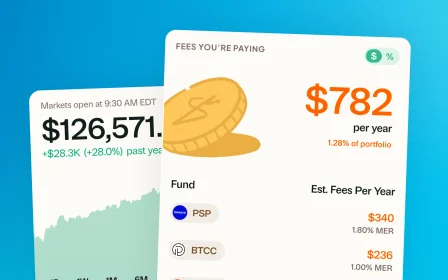
A couple of them offered to pay me a percentage to manage their money. One friend suggested 5%. I was floored. Not because he was being generous, but because he had no idea that 5% is an enormous fee. He’d never been taught what a reasonable fee looks like. Is 3% high? Is 1% fine? He had no frame of reference. None of them did.
That’s not their fault. Nobody ever sat them down and explained how investment fees work. Nobody explained that a 1% fee might sound small but is 18 times more than 0.05%. Small percentages flatten real differences, and everyone, even people who know better, glazes over them. I still fall for it myself sometimes.
Analysis confidence vs. action confidence
I could see the opportunity in Apple in 2007. I could see Lululemon was going to be huge. I was reading, researching, paying attention. But I couldn’t put money behind it. The gap between knowing something is a good move and actually doing it is enormous, especially when you’re young and nobody around you is investing.
This is the thing I’d fix if I could go back. Not the stock picks. Not the account type. Just the act of starting. Doing anything at all. The first $100 invested matters less for the returns it generates than for the person it turns you into: someone who invests. Once you cross that line, everything else follows.
If you’re in your 20s and you haven’t started yet, the best day to start was years ago. The second best day is today. That’s not a cliché. It’s just math. And the longer you wait, the more the math moves against you.
Figuring out where to start is the hardest part. Once you’re past that, the rest is surprisingly simple. And if you want to skip the learning curve on the stuff that trips people up early, I put together a list of the most common mistakes new investors make.
More in Your First Moves
How much do you need to start investing?

Where to start as a new Canadian investor
Time in the market beats timing the market
The most common mistakes new Canadian investors make
How much do you need to start investing?
The '$1,000 minimum' is a myth that keeps people on the sidelines. Here's what Canadian brokerages actually require to open an account and start.
Where to start as a new Canadian investor
Time in the market beats timing the market
Staying invested through downturns almost always beats trying to buy low and sell high. Here's why the boring strategy wins.