What you're actually paying in investment fees


Part 1 of 6
This article is part of our Understanding your investments series.
Short answer: The main fees Canadian investors pay are MERs (typically 0.20% to 2.5% depending on the fund), trading commissions ($0 at most online brokerages now), and currency conversion (around 1.5% to 2% on most CAD/USD trades). Fees compound the same way returns do, in reverse.
A good friend and coworker saw “bank appointment” on my work calendar one morning and sent me a message. He worked in financial services. All he said was: don’t let them sell you mutual funds. I assured him I was just setting up a self-directed account. But I was grateful he said something, because he knew what most people don’t: the gap between what you’re told you’re paying and what you’re actually paying is enormous.
When friends started asking me for investing help a few years later, a couple of them offered to pay me 10% to manage their money. I was floored. Not because they wanted help, but because they thought 10% was a normal number. They had no frame of reference. Is 3% high? Is 1% fine? Nobody teaches you this. A 2024 IFIC/Pollara survey found that only 67% of Canadian investors feel confident they understand the fees they pay. That means a third don’t.
Fees are the thing too many investors never think about and the thing that has one of the biggest impacts on your long-term returns. This isn’t financial advice, just a breakdown of where your money might be going and what to watch for. Brokerages and fund providers update their fee structures regularly, so the specific numbers here may shift. The principles stay the same.
The MER: the fee you never see
The Management Expense Ratio (MER) is the annual fee charged by a fund to cover management, operations, and administration. It’s expressed as a percentage of your investment, and it’s deducted automatically from the fund’s value. You never see a line item for it. Your returns are just slightly lower than they would have been.
Here’s how MERs typically compare:
| Investment type | Typical MER | Cost on $100,000/year |
|---|---|---|
| Bank mutual funds | 1.5%–2.5% | $1,500–$2,500 |
| Tangerine / low-cost mutual funds | 0.65%–1.10% | $650–$1,100 |
| All-in-one ETFs (XEQT, VGRO, etc.) | 0.20%–0.25% | $200–$250 |
| Individual index ETFs | 0.03%–0.10% | $30–$100 |
According to Morningstar’s 2025 Canada Fund Fee Study, the average Canadian mutual fund charges 1.33% and the average ETF charges 0.66%. The ETF vs mutual fund guide breaks down what that fee gap actually costs over decades and when each vehicle still makes sense.
2% and 0.20% look like nearly the same number. Your eyes skip right past them. But one is ten times more than the other. Over 25 years, on a $100,000 portfolio growing at 7%, that difference costs you roughly $180,000.
That’s not a typo. Fees compound just like returns do, except they work against you. They’re also one of the reasons calculating your real return is trickier than it looks.
Fees compound just like returns do, except they work against you.
Trading commissions
This is the fee you pay each time you buy or sell a stock or ETF. It used to be the biggest cost for DIY investors. Some brokerages charged $9.99 per trade, which made it expensive to invest small amounts regularly.
That’s changed. Wealthsimple offers commission-free trading on everything. Questrade offers free ETF purchases. Even some bank brokerages have started reducing or eliminating commissions on certain products. If you’re weighing those two, the Wealthsimple vs Questrade comparison breaks down where the fee differences actually matter.
If you’re investing small amounts every payday, commission-free ETF purchases aren’t a nice-to-have. They’re essential.
Currency conversion fees
If you buy U.S.-listed stocks or ETFs, your brokerage converts your Canadian dollars. Most charge a spread of 1.5% to 2.5% on the exchange rate. On a $5,000 purchase, that’s $75 to $125, gone before you’ve even invested.
This is one of the most overlooked fees in Canadian investing. Some brokerages support workarounds (like Norbert’s Gambit) that reduce this cost dramatically. Others don’t. It’s worth checking which platforms support this before you buy anything U.S.-listed.
Account fees
Some brokerages charge maintenance fees if your account is below a certain balance. Others charge for inactivity. Transfer-out fees ($50–$150) are common when you move your account to a new brokerage.
These fees are usually small individually, but they add up if you’re not paying attention. When I started out with a small account at a bank brokerage, I was paying quarterly fees I didn’t even know about until I looked at my statements closely.
The fee you’re paying your advisor
If you’re working with a financial advisor at a bank, there’s a good chance you’re paying more than you realize. Many bank advisors put clients into funds with MERs of 2% or higher, which includes their compensation. They don’t typically charge you a visible fee. Instead, the cost is built into the products they recommend.
I hear people say “as long as my advisor didn’t lose me money, I’m happy” all the time. Or “my mutual fund is up 11% this year, how can that be bad?” But if a basic index fund returned 16% that same year, your “good” return actually underperformed by 5 percentage points. You left real money on the table, and the fees are a big part of why. I used to celebrate returns like that too, until I started comparing them to what a simple index fund did over the same period.
According to the S&P SPIVA Canada Scorecard, 98.3% of Canadian equity funds underperformed their benchmark over a 10-year period. That doesn’t mean every actively managed fund is bad. But if the vast majority of professional fund managers can’t beat the index after fees, it’s worth asking what you’re paying for. Some advisors provide real value, especially for complex tax or estate planning. But if you’re investing in a basic mix of stocks and bonds, it’s worth knowing what you’re paying for, and what you’re getting in return.
How to find out what you’re paying
Every fund lists its MER in its “Fund Facts” document. Your brokerage is also required to send you an annual fee report showing the total fees you paid that year. If you’ve never looked at yours, here’s how to actually read it.
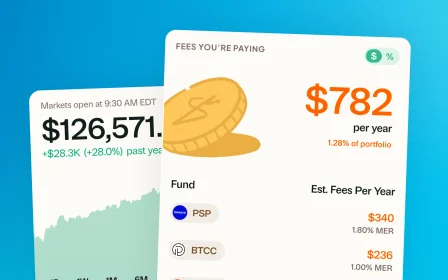
Greenline surfaces your fees alongside your portfolio so you can actually see what you’re paying, all in one place.
Find out exactly what you're paying in fees across all your funds Seeing it all in one place is what we built Greenline to do, if you ever want a hand.
More in The Fine Print

Not all ETFs are created equal

Brokerage comparison: what to look for in Canada

How to read your brokerage statement
Not all ETFs are created equal
ETFs have become shorthand for 'low-cost, passive investing.' But some charge fees that would make a mutual fund blush. Here's how to tell the difference.
Brokerage comparison: what to look for in Canada