
Capital Gains
The profit you make when you sell an investment for more than you paid for it.
A capital gain is the profit you earn when you sell an investment for more than what you originally paid. If you bought a stock for $1,000 and sold it for $1,500, your capital gain is $500. If you sold it for less than you paid, that’s called a capital loss.
How capital gains are taxed in Canada
In a regular (non-registered) account, capital gains are taxable. But you don’t pay tax on the full amount. In Canada, only 50% of your capital gains are added to your taxable income. So if your capital gain is $500, only $250 gets added to your income for tax purposes.
Capital losses can be used to offset capital gains, which can lower your tax bill. If you sold one stock at a $500 gain and another at a $300 loss, you’d only be taxed on $200 in net gains.
Why it matters
If you invest inside a TFSA, capital gains are completely tax-free. Inside an RRSP, you won’t pay capital gains tax either, but you’ll pay income tax when you eventually withdraw. In a non-registered account, understanding how capital gains work helps you make smarter decisions about when to sell and how to manage your tax situation.
You don’t owe anything until you actually sell. An investment can double in value, but as long as you hold it, there’s no tax to pay. That’s called an unrealized gain. The tax only kicks in when you sell and “realize” the gain. Our non-registered account guide covers how capital gains taxes work in practice.
A concrete example
You buy 200 shares of a Canadian stock at $25 each, for a total cost of $5,000. Three years later, you sell all 200 shares at $38 each, for $7,600. Your capital gain is $2,600. At the 50% inclusion rate, $1,300 gets added to your taxable income. If your marginal tax rate is 30%, you’d owe $390 in tax on that gain. Inside a TFSA, you’d owe nothing.
In Greenline
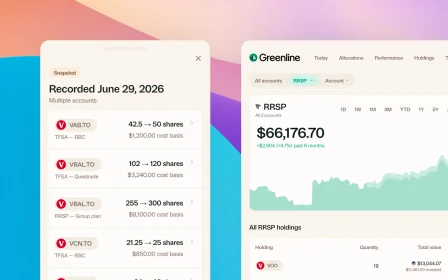
Greenline tracks your unrealized and realized capital gains across all your accounts.
Related terms
Adjusted Cost Base (ACB)
The average cost of your investment, used to calculate how much tax you owe when you sell.
Tax-Free Savings Account (TFSA)
A Canadian registered account where your investments grow and can be withdrawn completely tax-free.
Phantom Distribution
A taxable distribution from a fund that gets reinvested automatically, so you owe tax on money you never actually received as cash.

Your money stays where it is. Greenline just makes sense of it.
See all your accounts in one view:
See your full portfolio