


Registered Retirement Savings Plan (RRSP)
A Canadian registered account where contributions lower your taxable income now, but withdrawals are taxed later.
An RRSP is a Canadian registered account designed to help you save for retirement. The core idea is a tax trade: you get a tax deduction when you put money in, your investments grow tax-free while they’re inside the account, and you pay tax when you take the money out.
If you earn $70,000 and contribute $10,000 to your RRSP, your taxable income drops to $60,000 for that year. That can mean a meaningful tax refund. The idea is that when you eventually withdraw in retirement, you’ll likely be in a lower tax bracket than during your working years, so you’ll pay less tax overall.
Contribution room
Your RRSP contribution limit is 18% of your previous year’s earned income, up to an annual maximum ($33,810 for 2026). Like a TFSA, unused room carries forward. You can check your exact limit on your CRA Notice of Assessment or by logging into your CRA My Account.
Why it matters
The RRSP is especially valuable if you’re currently in a higher tax bracket and expect to be in a lower one when you retire. The tax deduction today is worth more than the tax you’ll pay later.
One thing to keep in mind: unlike a TFSA, withdrawals from an RRSP are added to your income and taxed at your marginal rate. There’s no “free withdrawal” option (outside of specific programs like the Home Buyers’ Plan). So the RRSP works best when you can leave the money alone until retirement. If you’re deciding between the two, our TFSA vs. RRSP guide walks through the tradeoffs.
In Greenline
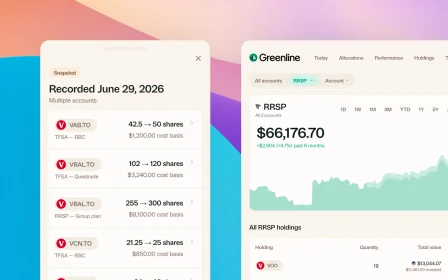
Greenline shows your RRSP holdings, performance, and fees alongside all your other accounts.
Related terms
Tax-Free Savings Account (TFSA)
A Canadian registered account where your investments grow and can be withdrawn completely tax-free.
Asset Allocation
How you divide your portfolio between stocks, bonds, and other types of investments.
Beneficiary Designation
A named person who receives the assets in your account when you pass away, often bypassing your will entirely.
Locked-In Retirement Account (LIRA)
A registered account that holds pension money from a former employer, with restrictions on when and how you can withdraw it.

Your money stays where it is. Greenline just makes sense of it.
See all your accounts in one view:
See your full portfolio