

Adjusted Cost Base (ACB)
The average cost of your investment, used to calculate how much tax you owe when you sell.
Your Adjusted Cost Base, or ACB, is the total cost of your investment adjusted for things like additional purchases, reinvested dividends, and return of capital. When you sell, the CRA uses your ACB to figure out your capital gain (or loss). The formula is straightforward: what you sold it for, minus your ACB, equals your capital gain.
Why it gets complicated
If you buy a stock once and sell it once, the math is simple. But few people invest that way. You might buy the same stock at different prices over several years. Each purchase changes your average cost per share.
Reinvested dividends (through a DRIP) also increase your ACB because you’re essentially buying more shares. And some ETFs distribute “return of capital,” which actually lowers your ACB, meaning you’ll owe more tax when you eventually sell. Our return of capital guide explains how this works.
If you don’t track your ACB properly, you might end up paying more tax than you need to, or reporting the wrong amount to the CRA.
Why it matters
Your brokerage may show a “book cost” or “average cost” on your account, but these numbers aren’t always accurate for tax purposes. Transfers between brokerages, corporate actions, and return of capital distributions can all throw off the number your brokerage displays.
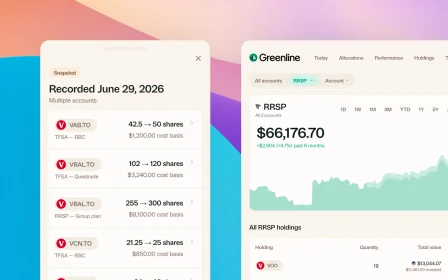
For investments held in a TFSA or RRSP, ACB doesn’t matter because there’s no capital gains tax inside those accounts. But for anything in a non-registered account, keeping an accurate ACB is important. Greenline tracks this for you automatically.
A concrete example
Say you buy 50 shares of an ETF at $40 each ($2,000 total), then buy another 50 shares a year later at $48 each ($2,400 total). Your ACB is now $4,400 for 100 shares, or $44 per share. If you sell all 100 shares at $52 each ($5,200), your capital gain is $5,200 minus $4,400, which is $800. Only $400 of that is taxable at the 50% inclusion rate.

Your money stays where it is. Greenline just makes sense of it.
See all your accounts in one view:
See your full portfolio