

Capital gains tax in Canada: what you actually owe


Part 1 of 6
This article is part of our Taxes and your portfolio series.
Short answer: A capital gain is the profit when you sell an investment for more than you paid. In a non-registered account, 50% of the gain is included in your taxable income at your marginal rate. Inside a TFSA, capital gains are tax-free; inside an RRSP, they’re tax-deferred until withdrawal.
The first time I sold something in my non-registered account for a profit, I felt good about it for about 24 hours. Then I started thinking about taxes. I knew capital gains were taxed. I’d heard the phrase “50% inclusion rate” and thought it meant I’d pay 50% tax on my gain. That sounded brutal.
It doesn’t mean that. But the way capital gains tax actually works in Canada isn’t obvious, and the small misunderstandings add up. Some people overpay because they don’t understand the math. Others underreport because they don’t realize certain things count as a gain. And a surprising number of people don’t know that their TFSA gains are completely tax-free, so they avoid selling winners for no reason.
None of this is financial or tax advice. Capital gains rules, especially the inclusion rate, have been a moving target in recent federal budgets. Always confirm the current rules with the CRA or a tax professional before making decisions based on what’s here.
What a capital gain is
A capital gain happens when you sell an investment for more than you paid for it. You bought something at one price, sold it at a higher price, and the difference is your gain.
If you bought shares for $10,000 and sold them for $14,000, your capital gain is $4,000. If you sold them for $8,000 instead, you’d have a $2,000 capital loss. Simple enough.
The price you paid, adjusted for things like additional purchases and reinvested dividends, is called your adjusted cost base (ACB). Getting your ACB right is the foundation of reporting your gains correctly.
The inclusion rate
Here’s the part that trips people up. In Canada, you don’t pay tax on the full capital gain. Only a portion of it, called the “inclusion rate,” gets added to your taxable income.
The current inclusion rate is 50%. That means if your gain is $4,000, only $2,000 gets added to your income. You pay tax on that $2,000 at your marginal tax rate.
The inclusion rate has changed before and could change again. In 2024, the federal government proposed increasing it to two-thirds on gains above $250,000, but that proposal was ultimately cancelled. As of 2026, it remains at 50% for all capital gains regardless of amount. It’s one of those numbers worth double-checking every year.
A worked example
Let’s say you earn $80,000 in salary and you sell investments in your non-registered account for a $20,000 capital gain. Here’s how the tax works.
The taxable portion of your gain is 50% of $20,000, which is $10,000. That $10,000 gets added to your $80,000 salary, making your total taxable income $90,000 for the year.
The extra $10,000 is taxed at whatever marginal rate applies to income between $80,000 and $90,000. Let’s say your combined federal and provincial rate in that bracket is roughly 35%. You’d owe about $3,500 in tax on a $20,000 gain.
That’s an effective tax rate of 17.5% on the gain itself (not 50%, not 35%). The inclusion rate and your marginal rate work together, and the result is usually much lower than people expect.
Capital gains in registered accounts
If the same $20,000 gain happened inside your TFSA, you’d owe exactly zero. Nothing. That’s the whole point of a TFSA. All growth, whether from capital gains, dividends, or interest, is completely tax-free.
In an RRSP, it’s a different kind of deal. You don’t pay capital gains tax on the growth, but when you eventually withdraw, the entire amount is taxed as regular income. So the gain is still taxed, just not as a capital gain. It’s taxed at your full marginal rate on withdrawal.
This is why the general advice is to fill up your registered accounts before investing in a non-registered account. Not because investing in a taxable account is bad, but because the tax treatment in registered accounts is significantly better.
How losses offset gains
Capital losses are the other side of the coin. If you sell an investment for less than your ACB, you have a capital loss. Losses can be used to offset gains, dollar for dollar.
If you have $10,000 in capital gains and $4,000 in capital losses in the same year, your net capital gain is $6,000. You only pay tax on the included portion of $6,000.
If your losses exceed your gains, you can carry the net loss back three years to offset gains you already paid tax on (and get a refund), or carry it forward indefinitely to offset future gains. Losses never expire, which makes them a surprisingly useful tax planning tool, especially during market downturns.
The lifetime capital gains exemption
You may have heard of a “capital gains exemption” in Canada. It exists, but it’s narrower than most people think. The Lifetime Capital Gains Exemption (LCGE) applies to qualifying small business corporation shares and certain farm and fishing property. As of 2026, the exemption is over $1 million for qualifying shares.
If you’re selling shares of a regular publicly traded company, or an ETF, or a mutual fund, this exemption does not apply. It’s specifically for private company shares that meet the CRA’s qualifying criteria. Worth knowing it exists, but not relevant for most everyday investors.
What counts as a “disposition”
Selling shares on the stock exchange is the obvious trigger for a capital gain or loss. But there are other situations the CRA considers a disposition (a fancy word for selling or transferring).
Transferring investments from a non-registered account into a TFSA or RRSP is treated as a sale at market value. If the investment has gone up since you bought it, you’ll owe capital gains tax on the transfer, even though you didn’t actually sell on the open market.
Gifting investments to someone else is also treated as a disposition at market value. And when someone passes away, all their investments are deemed disposed of at fair market value on the date of death, which can create a significant tax bill for the estate.
How to minimize capital gains tax
There are a few legitimate strategies.
Use your registered accounts first. The simplest way to avoid capital gains tax is to invest inside your TFSA, RRSP, and FHSA where gains aren’t taxed (or are deferred). This is the biggest lever most people have.
Be thoughtful about when you sell. If you’re expecting a low-income year (career break, parental leave, early retirement), that’s a better time to realize gains because your marginal rate will be lower.
Harvest your losses. If you have positions sitting at a loss, you can sell them to offset gains. This is called tax-loss harvesting, and it’s one of the more practical tax strategies for non-registered accounts.
Hold for the long term. Capital gains tax is only triggered when you sell. If you hold an investment for decades, you defer the tax for decades. Time is a free tax planning tool.
Reporting to the CRA
Capital gains and losses are reported on Schedule 3 of your tax return. For each sale, you’ll need: the name of the investment, the date sold, the proceeds of sale, and your ACB. The difference is your gain or loss.
If you had many transactions during the year, this can get tedious. Keeping accurate records throughout the year, especially your ACB, makes tax time much less painful.
Your brokerage will send you tax slips, but they may not calculate your ACB correctly, especially if you’ve transferred shares between accounts or institutions. The CRA expects you to verify the numbers yourself.
The tax you owe might be less than you think
Capital gains tax sounds intimidating, but once you understand the inclusion rate and how marginal rates work, the actual amount is often lower than people fear. A $10,000 gain doesn’t mean a $5,000 tax bill. For most Canadians, it means somewhere between $1,500 and $2,500, depending on your province and income level.
The bigger lesson is that capital gains tax is a good problem to have. It means your investments grew. The goal is to keep more of that growth by using the right accounts, tracking your ACB, and being strategic about when and how you sell.
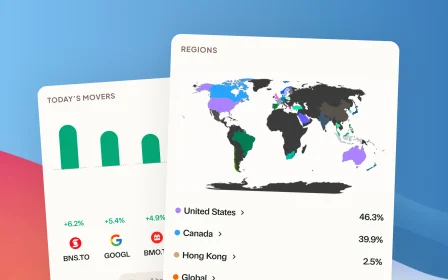
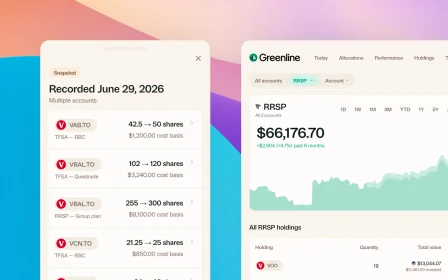
Greenline tracks your realized and unrealized gains across every account, with ACB calculated as a starting point, so you have a clearer picture before tax season (though it’s worth verifying before filing).
Track your capital gains across all your accounts If you ever want everything you own in one view, that's what Greenline is for.
More in The Fine Print

What to do after maxing your registered accounts

The non-registered account, explained
TFSA vs RRSP: Which should you max out first?
Investment tax in Canada, simplified
What to do after maxing your registered accounts
You've filled your TFSA, RRSP, and FHSA. Now what? Non-registered accounts, capital gains, tax-loss harvesting, and where to put the overflow.
The non-registered account, explained
TFSA vs RRSP: Which should you max out first?
The classic Canadian investing question. A clear, no-jargon breakdown of when to prioritize your TFSA, when to lean into your RRSP, and why it depends.