

Tax-loss harvesting in Canada


Part 3 of 6
This article is part of our Taxes and your portfolio series.
Short answer: Tax-loss harvesting means selling an investment at a loss in a non-registered account to offset capital gains and reduce your tax bill. Watch the superficial loss rule: if you (or your spouse) buy back the same or identical security within 30 days, the loss is denied.
The first time I saw a position down 20%, my instinct was to look away and pretend it wasn’t happening. That’s the normal reaction. What nobody told me early on is that in a taxable account, a loss sitting in your portfolio isn’t just a loss. It’s a tool. You can sell it, realize the loss, and use it to reduce the tax you owe on your gains, either this year or in a future year.
It’s called tax-loss harvesting, and once you understand the mechanics, it’s one of the more useful things you can do in a non-registered account.
This is not financial or tax advice. Tax rules change, and the specifics around capital gains and losses get updated regularly. Check with a tax professional before making moves based on what you read here.
What tax-loss harvesting actually is
The concept is simple. If you own an investment that’s worth less than what you paid for it, you can sell it to “realize” that loss. A realized capital loss can be used to offset realized capital gains, which reduces your tax bill.
Say you sold one investment earlier in the year for a $5,000 gain. You owe capital gains tax on that. But you also have another investment sitting at a $3,000 loss. If you sell it, your net gain for the year drops to $2,000. You only pay tax on the $2,000.
You haven’t made the loss disappear. The loss was already real. You’ve just made it useful.
When it makes sense
Tax-loss harvesting only applies in non-registered (taxable) accounts. Inside a TFSA, RRSP, or FHSA, gains aren’t taxed, so losses have no tax value. If you’re only investing inside registered accounts, this guide isn’t relevant to you yet. But once you’ve maxed those out and started investing in a taxable account, this becomes worth knowing.
It makes the most sense when you have realized gains in the same year that you want to offset. It also makes sense if you expect to have significant gains in the next few years, because unused capital losses can be carried forward indefinitely.
The superficial loss rule
Here’s where most people trip up. You can’t sell an investment at a loss and immediately buy it back. The CRA has a rule called the superficial loss rule, and it exists specifically to prevent people from doing exactly that.
The rule says: if you sell an investment at a loss and buy the same or identical investment within 30 days before or after the sale, the loss is denied. That’s a 61-day window total. Thirty days before the sale, the day of the sale, and 30 days after.
This applies to you, your spouse, and any corporation you control. So you can’t sell at a loss in your account and have your spouse buy the same thing the next day.
If the loss is denied, it gets added to the ACB of the repurchased shares. It’s not gone forever, but you don’t get to use it this year. It just defers the benefit.
The ETF swap strategy
So if you can’t buy back the same investment, what do you do? You buy something similar but not identical.
This is where ETF swaps come in. Say you own VFV (an S&P 500 ETF from Vanguard) and it’s sitting at a loss. You sell VFV and immediately buy XUS (an S&P 500 ETF from iShares). Both track the same index. Both give you essentially the same market exposure. But they’re different products from different providers, so the CRA doesn’t consider them identical.
You’ve realized your loss, maintained your market exposure, and stayed within the rules.
Common swap pairs that Canadian investors tend to use include VFV and XUS (S&P 500), XAW and VXC (international), and ZAG and XBB (bonds). Whether two ETFs are considered “identical property” is ultimately a factual determination by the CRA, not something they publish an approved list for, so do your own research. The key is that the replacement must be a different fund, not just a different share class of the same fund.
After 30 days, if you prefer the original ETF, you can sell the replacement and buy back the original. Or you can just keep the replacement. Either way works.
Carrying losses forward (and back)
If your capital losses in a given year exceed your capital gains, you have a net capital loss. You can carry that loss back up to three years to offset gains you already paid tax on (and get a refund), or carry it forward indefinitely to offset future gains.
This is genuinely useful. A bad year in the market doesn’t just feel bad. It creates a tax asset you can use later.
The CRA lets you apply net capital losses against capital gains in any future year, with no expiry.
To carry a loss back, you file a T1A form with your tax return. To carry it forward, you just report it and the CRA tracks it for you.
What to watch out for
Don’t let the tax tail wag the investment dog. Saving a few hundred dollars in tax isn’t worth selling an investment you genuinely believe in. Tax-loss harvesting works best when you can maintain equivalent exposure through a swap, not when it pushes you into a worse portfolio.
Track your ACB carefully. When you sell at a loss and buy a replacement ETF, your adjusted cost base on the new position is whatever you paid for it. If you later swap back, you need to track that too. Every transaction matters.
Watch the 30-day window closely. The superficial loss rule is strict. If you accidentally buy back within the window, through a DRIP reinvestment, a pre-authorized contribution, or a purchase in your spouse’s account, the loss gets denied. Turn off DRIPs for the relevant holding before you harvest.
Don’t harvest in registered accounts thinking it helps. Losses realized inside a TFSA or RRSP cannot be used to offset gains anywhere. In fact, if you transfer a losing investment into a TFSA, that loss is gone entirely. You can’t claim it.
The CRA reporting side
When you report your capital gains and losses, you use Schedule 3 of your tax return. You’ll list each disposition: the proceeds of sale, the ACB, and the resulting gain or loss. If you have a net capital loss, it flows through to your return and can be carried forward or back.
Keep detailed records. The date of each sale, the proceeds, the ACB, and, if you did a swap, what you bought and when. The CRA can ask for documentation, and “I think it was around that price” doesn’t hold up.
A real scenario
Let’s put it together. You’re investing in a non-registered account. During the year, you sold a Canadian bank stock for a $4,000 capital gain. You also hold VFV, which is currently sitting at a $2,500 unrealized loss.
In December, you sell VFV and buy XUS the same day. You’ve realized a $2,500 loss. Your net capital gain for the year is now $1,500. At a 50% inclusion rate and a 40% marginal tax rate, that harvested loss saved you about $500 in tax.
You still own an S&P 500 ETF. Your portfolio is essentially unchanged. You just paid less tax.
Small move, real savings
Tax-loss harvesting isn’t glamorous. It won’t make you rich. But in a taxable account, it’s one of the few things entirely within your control that can reduce your tax bill without changing your investment strategy. The best time to think about it is during market downturns, which, ironically, is when most people are too busy worrying to think about taxes.
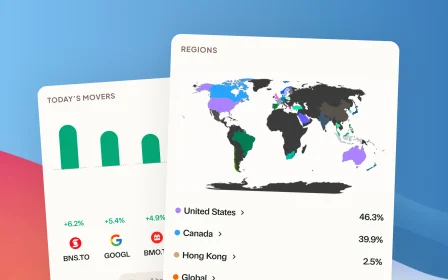
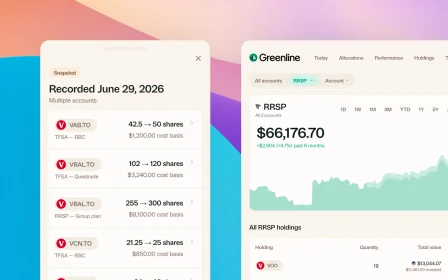
Greenline tracks your unrealized gains and losses across every holding, making it easy to spot harvesting opportunities before year-end.
The fees, the returns, the details buried in your statements add up, once you can actually see them in one place. If you ever want everything you own in one view, that's what Greenline is for.
More in The Fine Print

What to do after maxing your registered accounts

The non-registered account, explained

What you're actually paying in investment fees

Investment tax in Canada, simplified
What to do after maxing your registered accounts
You've filled your TFSA, RRSP, and FHSA. Now what? Non-registered accounts, capital gains, tax-loss harvesting, and where to put the overflow.
The non-registered account, explained
What you're actually paying in investment fees
Too many investors have no idea what they're paying in fees. MERs, trading commissions, currency conversion. Here's where your money is quietly going.