

What to do after maxing your registered accounts


Part 6 of 9
This article is part of our Going deeper series.
Short answer: Once your TFSA, RRSP, and FHSA are full, the next stop is a non-registered (taxable) account. You’ll pay tax on capital gains, dividends, and interest, so asset location and tax efficiency start to matter more than they did inside registered accounts.
A while back, a friend offered to pay me 10% to manage his investments. He was dead serious. I told him that was absurdly high, that even the most expensive advisors don’t charge that much, and that he could do it himself for a fraction of the cost. But the conversation stuck with me, because here was someone who’d been investing for years, had maxed out his TFSA and RRSP, and still felt completely lost about what to do next.
It’s a good problem to have. Genuinely. If you’re at the point where your registered accounts are full, you’ve already done the hardest part, which is starting. But the next step, investing in a non-registered (taxable) account, comes with a new set of rules you may never have had to think about before.
This isn’t financial or tax advice. Just what I’ve picked up as someone who reached this point and had to figure it out on my own. Tax rules are updated in every federal budget. Capital gains inclusion rates, in particular, have been a moving target. Verify everything with the CRA or a tax professional.
What is a non-registered account?
A non-registered account (sometimes called a taxable account, margin account, or just a regular investment account) is exactly what it sounds like: an account that isn’t registered with the CRA for special tax treatment. No contribution limits. No withdrawal restrictions. No alphabet soup acronym.
You can hold the same investments here as in your TFSA or RRSP, stocks, ETFs, bonds, GICs, everything. The difference is that investment income earned in this account is taxable. That includes capital gains, dividends, and interest.
How capital gains work
When you sell an investment for more than you paid, the profit is a capital gain. In Canada, capital gains are taxed, but not at your full income tax rate. Only 50% of the gain gets added to your taxable income.
For example, if you bought shares for $10,000 and sold them for $15,000, your capital gain is $5,000. Only the included portion of that gets added to your income and taxed at your marginal tax rate. The rest is yours to keep.
This is more favourable than interest income (which is taxed at your full rate) and comparable to eligible dividend income depending on your tax bracket. It’s one of the reasons equities in a taxable account can still be a good deal, even without the registered account tax shelter.
Tax-loss harvesting: turning losses into a tool
Here’s something you can do in a non-registered account that you can’t do in a TFSA or RRSP. If one of your investments drops in value and you sell it at a loss, that loss can be used to offset capital gains from other investments. This is called tax-loss harvesting.
Say you realized $3,000 in capital gains from selling one ETF, but another holding is sitting at a $2,000 loss. If you sell the losing holding, your net capital gain drops to $1,000, which means less tax. You can even carry capital losses forward to future years or back to the previous three years.
One thing to watch: the superficial loss rule. If you sell a stock at a loss and buy the same stock (or an identical one) within 30 days, before or after, the CRA disallows the loss. So you can’t just sell and immediately rebuy. But you can buy a similar, not identical, ETF to stay invested in the same market.
Asset location: what goes where
Once you have multiple account types, it starts to matter which investments you hold in which account. This concept is called asset location (not to be confused with asset allocation, which is what you invest in).
The general principle: hold the most tax-inefficient investments in your registered accounts, and the most tax-efficient ones in your non-registered account. Here’s a rough guide:
| Investment type | Best held in | Why |
|---|---|---|
| Bonds / GICs | RRSP | Interest income is taxed at your full rate. Shelter it. |
| U.S. dividend stocks | RRSP | U.S. withholding tax is waived in RRSPs (not in TFSAs). |
| Canadian dividend stocks | Non-registered | Eligible dividends get favourable tax treatment outside registered accounts. |
| Growth stocks / ETFs | TFSA | All growth is completely tax-free. Let your winners run here. |
This isn’t a hard rule. If you’re using all-in-one ETFs like XEQT across all accounts, that’s simpler and still effective. But if you’re starting to build a more customized portfolio, asset location can save you real money over time.
A note on corporate accounts
If you own a business and have retained earnings in your corporation, a corporate investment account is another option. This is a more advanced strategy with its own set of rules around passive income, refundable taxes, and the capital dividend account. It’s beyond the scope of this article, but if you’re a business owner and your registered accounts are full, talk to an accountant about whether investing through your corporation makes sense.
The progression
Looking back, my investing path followed a pretty predictable arc. First, figuring out what a TFSA and RRSP even were. Then maxing them out. Then learning about newer accounts like the FHSA. And finally arriving at the question: “What do I do with the rest?”
Each stage felt like a new level unlocking. The first few levels are about getting started and using the tools the government gives you. The non-registered account level is about understanding that investing doesn’t stop once the tax-sheltered room runs out. It just requires a bit more tax awareness.
If you’re reading this and you haven’t filled your registered accounts yet, that’s probably where to focus first. Thegetting started guide walks through the basics. But if you’re past that point, welcome to the overflow. It’s a good place to be.
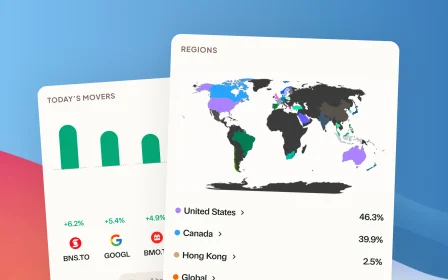
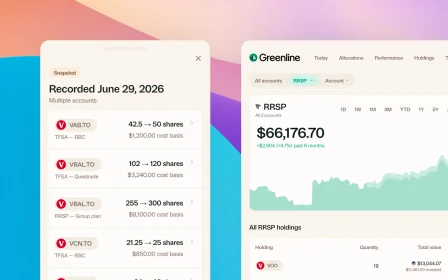
Greenline tracks all your accounts in one view, registered and non-registered, so you can see how your full portfolio is performing.
A TFSA here, an RRSP there, an FHSA somewhere else. The hard part is seeing them as one picture. It's the sort of thing we built Greenline for, if that'd ever be useful to you.
More in The Account Maze

TFSA vs RRSP: Which should you max out first?

How dividends work (and get taxed) in Canada

How to start self-directed investing in Canada
TFSA vs RRSP: Which should you max out first?
The classic Canadian investing question. A clear, no-jargon breakdown of when to prioritize your TFSA, when to lean into your RRSP, and why it depends.
How dividends work (and get taxed) in Canada