What financial advisors actually do (and cost)


Part 2 of 6
This article is part of our Understanding your investments series.
Short answer: Canadian financial advisors typically charge 1% to 2.5% a year. DIY through a low-fee ETF costs around 0.20%. Robo-advisors sit in between at roughly 0.40% to 0.50%. Advisors are most useful for tax planning, estate planning, and behaviour coaching, not for picking investments.
For most of my investing life, I’ve been doing it myself. Not because I think advisors are bad, but because when I was getting started, I didn’t know the difference between a financial advisor, a bank teller, a mutual fund salesperson, and a stockbroker. They all seemed like “money people.” I didn’t know who to trust, what they’d cost, or what I’d actually get for my money. So I just figured it out on my own.
That worked for me. It doesn’t work for everyone. And the uncomfortable truth is that a lot of people who should be getting help aren’t, and a lot of people who are getting “help” are paying for something that isn’t really helping them.
A lot of people who should be getting financial advice aren’t, and a lot of people who are getting “advice” are paying for something that isn’t really helping them.
This isn’t financial advice, and I’m not telling you whether to use an advisor or not. But the industry is worth understanding.
The title means less than you’d think
In Canada, the title “financial advisor” isn’t as tightly regulated as you might expect. Different people using that title can have very different qualifications, offer very different services, and get paid in very different ways.
Here’s a rough breakdown:
| Title | What they typically do | How they typically get paid |
|---|---|---|
| Bank advisor | Recommends the bank’s own products (mutual funds, GICs) | Salary + commissions/bonuses tied to sales |
| Mutual fund representative | Licensed to sell mutual funds | Commissions from the funds they sell (trailing commissions) |
| Investment advisor / portfolio manager | Manages your portfolio directly, can buy/sell securities | Usually a percentage of assets under management (AUM), often 1-1.5% |
| Fee-only financial planner | Creates a comprehensive financial plan (tax, estate, retirement, insurance) | Flat fee or hourly rate. Doesn’t sell products or earn commissions |
| Robo-advisor | Algorithm-driven portfolio management with some human oversight | Low AUM fee, usually 0.25-0.50% |
The person at your bank branch and a fee-only financial planner might both call themselves “financial advisors.” One is selling you the bank’s products. The other is paid only by you, with no incentive to recommend one product over another. That’s a significant difference.
How much do financial advisors cost in Canada?
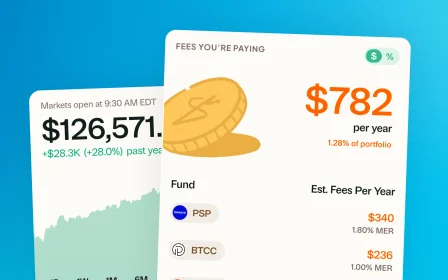
Understanding what you’re paying an advisor is harder than it should be, because the fees are often invisible. Canada introduced CRM2 fee disclosure rules to show investors what they’re paying, but research consistently shows that most people don’t change their behaviour even after seeing the numbers. The fees are real, but they don’t feel real when they’re baked into a fund’s returns.
If you’re working with a bank advisor and they put you in mutual funds, you’re likely paying an MER of 1.5-2.5% per year on your investments. Part of that MER goes to the advisor as a trailing commission. On a $200,000 portfolio, that’s $3,000 to $5,000 per year, and you may never see it as a line item because it’s deducted from the fund’s returns before you see them.
An AUM-based advisor charging 1% on a $200,000 portfolio costs $2,000 per year, plus whatever the investments themselves charge in MERs. As your portfolio grows, so does the dollar amount you’re paying, even though the percentage stays the same. At $1 million, that’s $10,000 a year.
A fee-only planner might charge $2,000 to $5,000 for a comprehensive financial plan, or $200 to $400 per hour for specific questions. You pay once, get the plan, and implement it yourself. No ongoing fee, no trailing commission, no percentage skimmed off the top. The fees guide goes deeper on how costs compound over time.
Financial advisor vs DIY vs robo-advisor: a cost comparison
Across a $200,000 portfolio, the three paths look roughly like this per year:
| Path | Annual cost on $200,000 | What you get |
|---|---|---|
| DIY with an all-in-one ETF | About $400 (0.20% MER) | Professionally designed, globally diversified portfolio. You manage contributions and rebalancing is handled inside the fund. |
| Robo-advisor | $900 to $1,400 (0.25% to 0.50% fee + ETF MERs) | Auto-rebalancing, automatic deposits, some tax-loss harvesting. Limited customization, no financial planning. |
| AUM advisor | $3,000 to $5,000 (1% to 1.5% fee + MERs) | Full-service relationship, behavioural coaching, access to a human when markets get rough. Quality varies a lot. |
| Fee-only planner (one-time) | $2,000 to $5,000 for a one-time plan | Comprehensive written plan covering tax, retirement, insurance, estate. You implement the investments yourself. |
Over 25 years on a $200,000 portfolio growing at 6%, the difference between paying 0.20% and paying 1.5% works out to roughly $200,000 in lost compounding. That’s not a reason to go DIY, it’s a reason to make sure whatever you’re paying for is actually worth it.
When is a financial advisor worth it?
There are situations where getting professional help makes a lot of sense:
Complex tax situations. If you have a corporation, rental income, stock options, or cross-border tax issues, a qualified financial planner can save you real money through proper tax planning. The advice pays for itself.
Major life transitions. Getting married, divorced, inheriting money, approaching retirement, selling a business. These moments have financial implications that are easy to get wrong and hard to undo.
Behavioural coaching. This one is underappreciated. A good advisor keeps you from panic-selling during a crash, from chasing hot stocks during a bubble, from making emotional decisions with your money. Studies suggest this behavioural coaching is the single most valuable thing an advisor provides, worth more than the investment selection or tax planning. If you know yourself well enough to know you’d make rash decisions on your own, paying for someone to keep you steady can be worth every dollar.
No interest in doing it yourself. Not everyone wants to learn about investing. Not everyone should have to. If managing your own portfolio sounds like a chore rather than something you’d enjoy, there’s nothing wrong with paying someone competent to handle it. The key word is competent.
When might I not need a financial advisor?
If your financial situation is relatively straightforward, a TFSA, an RRSP, maybe an FHSA, steady employment, no major complications, you can probably manage your own investments without paying someone ongoing fees.
The self-directed investing guide walks through how to open an account and get started. An all-in-one ETF gives you a diversified, professionally designed portfolio for 0.20% per year. That’s the same kind of diversification an advisor would build for you, at a fraction of the cost.
A middle path: get a fee-only financial plan done once every few years to make sure you’re on track, and manage the day-to-day investing yourself. You get the professional perspective without the ongoing cost.
Questions worth asking
If you’re considering working with an advisor, a few questions that can tell you a lot:
How are you compensated? If they hesitate or can’t give a clear answer, that’s a red flag. You should know exactly how they make money, whether it’s from you directly, from the products they sell, or both.
Are you a fiduciary? A fiduciary is legally required to act in your best interest. Not all advisors in Canada are held to this standard. Some are only required to recommend products that are “suitable,” which is a much lower bar.
What would you recommend for someone who doesn’t want to pay ongoing fees? If their answer is “well, you really need ongoing management,” and your situation is straightforward, that might say more about their business model than your needs.
Can I see a sample financial plan? If you’re paying $3,000 for a plan, you should know what you’re getting. A good plan covers your full picture: tax optimization, insurance needs, retirement projections, estate basics, and an investment strategy. A weaker one might feel more like a sales pitch in a binder.
The real gap
The financial industry in Canada has a gap in the middle. On one end, you have bank advisors selling high-fee products to people who don’t know there are cheaper options. On the other end, you have self-directed investors managing everything themselves. The space in between, affordable, unbiased professional guidance, is harder to find than it should be.
Fee-only planners fill that gap, but they’re still relatively rare in Canada, and many people don’t know they exist. Organizations like the FP Canada Institute and the Money Coaches Canada network can help you find one.
My own path was entirely self-directed, partly by choice and partly because I didn’t know the alternatives. If I were starting over today, I’d probably get a fee-only plan done early on, just to make sure my foundation was solid, and then manage things myself from there. That self-directed path, and all the visibility gaps that come with it, is actually what led me to build Greenline.
More in Your First Moves

How to start self-directed investing in Canada

What you're actually paying in investment fees

Just buy XEQT? The one-ETF strategy explained
Robo-advisor vs self-directed investing in Canada: which is right for you?
How to start self-directed investing in Canada
You don't need a financial advisor to invest in Canada. Here's how to open a self-directed account, pick your first investments, and actually get started.
What you're actually paying in investment fees
Just buy XEQT? The one-ETF strategy explained
'Just buy XEQT' has become the go-to answer in Canadian investing. Here's what XEQT actually holds, why it works for most people, and when you want more.