


Why your investment returns are so confusing


Short answer: Investment returns can be calculated three different ways (simple, time-weighted, money-weighted) and produce three different numbers, all “correct.” Time-weighted measures how the investment performed; money-weighted measures how your money performed; simple math ignores the timing of your contributions entirely.
I once spent an entire Saturday afternoon with a spreadsheet trying to figure out my actual investment return for the year. I had the data. I knew what I started with, what I ended with, and every deposit in between. It should have been simple math. It was not.
My brokerage said I was up 11%. My spreadsheet said 8%. A different formula gave me 13%. Three different numbers, all technically “correct,” just measuring different things. That afternoon was the moment I realized that calculating your investment return is genuinely one of the hardest problems in personal finance. And it’s the reason Greenline exists.
Calculating your actual investment return is genuinely one of the hardest problems in personal finance.
This is not financial advice, just my attempt to explain something that confused me for years. The math here is standard, but brokerages use different methods, and reporting practices can change. Always confirm how your platform calculates returns.
The simple math that doesn’t work
The intuitive way to calculate your return is simple: I started with $10,000, now I have $11,000, so I’m up 10%. And if you invested one lump sum and never touched it, that math is actually fine.
But nobody invests like that. You add money throughout the year. You contribute on payday, maybe skip a month, maybe add a big chunk from a bonus. Every deposit changes the equation. Did your portfolio grow because your investments went up, or because you put more money in? Simple return math can’t tell the difference.
That’s why there are two more sophisticated methods, and understanding the difference between them is the key to actually knowing how you’re doing.
Time-weighted return: how did the investments perform?
Time-weighted return (TWR) strips out the impact of your deposits and withdrawals. It answers the question: “How did the underlying investments do?” If you had invested a single dollar on day one and never touched it, what would your return have been?
This is the method used by mutual funds, ETFs, and professional benchmarks. When a fund says “we returned 12% this year,” they’re using time-weighted return. It’s fair for comparing one fund against another, because it removes the effect of investor behaviour (when and how much you added or withdrew).
The downside? It might not reflect your personal experience at all. If you invested a large amount right before a dip and a small amount right before a rally, your actual result is very different from the time-weighted number. But TWR doesn’t care about that. It only measures the investments themselves.
Money-weighted return: how did you personally do?
Money-weighted return (MWR), sometimes called the internal rate of return or XIRR, factors in the timing and size of every deposit and withdrawal. It answers the question: “What was my actual personal return, given when I added and removed money?”
This is the number most individual investors actually care about. If you dumped $20,000 in right before the market dropped 15%, the money-weighted return reflects that pain. If you dollar-cost averaged $500 a month through a rocky market and came out ahead, it reflects that too.
Here’s a quick way to think about the two:
| Method | What it measures | Best for |
|---|---|---|
| Time-weighted (TWR) | Investment performance, regardless of cash flows | Comparing funds, benchmarks, advisors |
| Money-weighted (MWR/XIRR) | Your personal return, including timing of deposits | Understanding your actual experience |
| Simple return | Ending value vs. starting value | Lump-sum investments with no additions |
Why the number on your brokerage might be wrong
Here’s what drove me crazy. Different brokerages use different methods, and most don’t tell you which one. Some show simple returns. Some show time-weighted. Some show a number that’s… unclear. And the method they pick can dramatically change whether you think you had a good year or a bad one.
On top of that, here are a few things that make the number even muddier:
- Dividends. Some return calculations include dividend income. Others only count price changes. If you hold a stock that paid 4% in dividends but the price was flat, one method says you made 4% and another says you made 0%.
- Currency fluctuations. If you own U.S. stocks and the Canadian dollar weakened, your portfolio might look like it went up, but some of that “gain” is just the exchange rate moving. Were your investments up, or was the loonie down?
- Fees. Some return numbers are shown before fees are deducted, others after. A fund showing 8% gross might only be 6% net.
- Capital gains vs. total return. Your brokerage might only show price appreciation, not total return (which includes dividends, distributions, and reinvested income).
When people say “I made 11% this year,” they usually don’t know which of these variables are included or excluded. And honestly, most have never thought about it. I certainly hadn’t until I started trying to reconcile my own numbers.
The spreadsheet obsession
After that frustrating Saturday, I didn’t give up. I built more spreadsheets. Elaborate ones. I tracked every deposit by date, every dividend payment, every currency conversion. I used XIRR formulas and manually calculated time-weighted returns by breaking my portfolio into sub-periods.
It worked. Eventually. But it took hours to maintain, broke constantly when I changed the format, and nobody else would ever want to use it. Meanwhile, friends kept asking me “how are your investments doing?” and I’d say “well, it depends on which method you mean.” Their eyes would glaze over. They just wanted a number. A real, honest number that accounted for everything.
That problem, giving people an honest return number that actually accounts for how they invest, is what pushed me to build Greenline.
The honest number
It’s surprisingly common to go years without truly understanding your returns. You see a number, feel good or bad about it, and move on. That’s fine for most people. But if you’ve ever looked at your portfolio and thought “wait, am I actually doing well or not?”, you’re asking the right question. The answer is just harder to get than it should be.
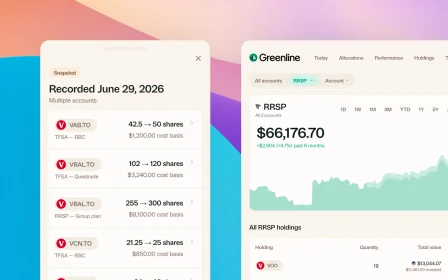
Greenline separates your contributions from your actual investment growth, so the return number you see reflects how your investments performed, not just how much you deposited.
The fees, the returns, the details buried in your statements add up, once you can actually see them in one place. If you ever want everything you own in one view, that's what Greenline is for.
More in The Fine Print

How to read your brokerage statement

What you're actually paying in investment fees

How dividends work (and get taxed) in Canada
Do you know how your portfolio is actually doing?

Time-weighted vs. money-weighted returns, explained simply
How to read your brokerage statement
It's more common than you'd think to get a brokerage statement and just ignore it. Here's what all those numbers mean, and why it's worth five minutes.
What you're actually paying in investment fees
How dividends work (and get taxed) in Canada
Do you know how your portfolio is actually doing?