

Your portfolio is one thing, not five accounts


Short answer: Your portfolio is one thing across all your accounts, not separate things in each. Looking at your TFSA in isolation can lead to over-concentration when paired with your RRSP and non-registered holdings.
For a long time, I thought about my money in pieces. My TFSA was “doing well.” My RRSP was “down a bit.” My non-registered account was “fine, I think.” I’d open each app, look at each balance, feel something about each one, and move on with my day.
It was like tasting every ingredient in a dish separately and deciding the meal was good because the salt was salty and the garlic was garlicky. I never actually tasted the whole thing together.
Then one day I sat down and added everything up on paper. Not the balances. The actual holdings. What I owned, across every account, combined into one list with real percentages. And the picture that emerged looked nothing like what I thought I’d built.
The account-by-account trap
When you look at each account in isolation, you make isolated decisions. Your TFSA has its own allocation. Your RRSP has its own allocation. Maybe your spouse’s accounts have their own allocations too. Each one looks reasonable on its own little pie chart.
But here’s the thing. You might be holding the same ETF in three accounts because it “looks good” in each one. You haven’t diversified. You’ve tripled your concentration in the same holdings without realizing it.
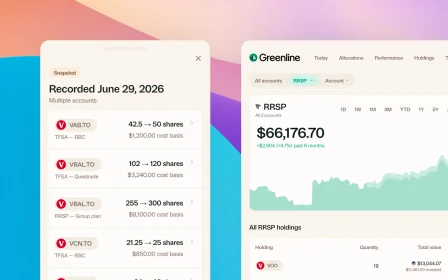
I had XEQT in my TFSA. I also had a very similar all-in-one fund in my RRSP. When I looked at them separately, each account seemed balanced. When I combined everything, I discovered my overall portfolio was basically the same fund twice, with slightly different wrappers. My “two balanced accounts” were really one portfolio with no meaningful variety.
The account view hides this. Each platform shows you its slice and nothing else. There’s no reason you’d notice the overlap unless you deliberately go looking for it.
What changes when you zoom out?
The moment you see everything together, a few things happen almost immediately.
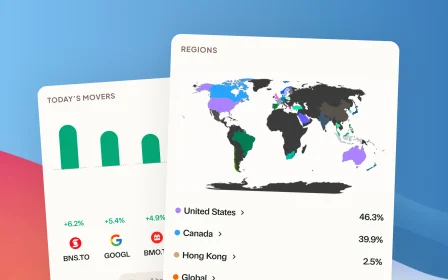
Your actual allocation becomes clear. Not what each account looks like, but what you really own across the board. Maybe you think you’re 70/30 stocks to bonds. You might be 90/10. You might have almost no bonds at all, because each account has “just a little” fixed income that adds up to nearly nothing.
Overlap becomes obvious. If three of your accounts hold broad U.S. equity exposure, you can see that you’re much heavier on U.S. stocks than you intended. Not because of one bad choice, but because the same reasonable choice was made three times in three places.
And you can start making smarter decisions about what goes where. Instead of treating each account like its own little portfolio, you can think about your entire portfolio as one thing and use each account for what it does best.
Asset location vs. asset allocation
These sound similar but they’re different concepts, and the distinction matters.
Asset allocation is what you own. Your mix of stocks, bonds, Canadian, international, sectors, the whole breakdown. This is the thing most people focus on, and rightly so.
Asset location is where you hold it. Which account type each investment sits in. And this part is quietly important because different accounts have different tax treatments.
A bond that pays interest income generates fully taxable income. If it’s sitting in your non-registered account, you’re paying tax on every dollar of interest. Move that same bond into your RRSP, and the interest is sheltered until you withdraw. That’s not a different investment. It’s the same investment in a smarter container.
Similarly, U.S. stocks that pay dividends face withholding tax in a TFSA, but not in an RRSP. Canadian dividend stocks get preferential tax treatment in a non-registered account. Growth-oriented equities that you plan to hold for years are often best in a TFSA, where the gains are completely tax-free.
You can only optimize any of this if you’re thinking across accounts. If each account is its own island, you’ll never even consider these trade-offs. This isn’t financial advice for your specific situation. But the principle is worth understanding.
The practical shift
You don’t need fancy software to start thinking this way. A piece of paper works.
List every holding you have, across every account. Write down the current value of each one. Add it all up. Then calculate the percentages. What portion of your total portfolio is in Canadian equities? U.S. equities? International? Bonds? Cash?
Most people are surprised by what they find. Maybe your Canadian home bias is much higher than you thought, because three of your four accounts lean toward Canadian stocks. Maybe you’re holding more cash than you realized, spread thinly across several accounts where it doesn’t look like much in any single one. Maybe your “diversified” portfolio is really just four slightly different versions of the same thing.
The exercise takes fifteen minutes. The insight lasts much longer.
Once you’ve done it, you can make decisions from the whole-portfolio perspective. Your next contribution doesn’t go into whatever account “feels right.” It goes into the account where it fills a gap in your overall allocation, held in the account type where it gets the best tax treatment.
The containers aren’t the portfolio
I think about it like this now. My TFSA, RRSP, and non-registered account are containers. Different shapes, different rules, different lids. But the stuff inside them is one collection, working toward one future.
When I check on my investments now, I don’t ask “how is my TFSA doing?” I ask “how is my portfolio doing?” It’s a small change in wording. It’s a meaningful change in thinking.
The accounts will always be separate. The tax rules will always be different. The logins will always be at different banks and brokerages. But the money is all yours, all connected, all pointing in the same direction. Once you start seeing it that way, you stop making decisions account by account and start making them for your whole financial picture.
That’s the shift. Your portfolio is one thing. The accounts are just where it lives.
Your portfolio is one thing. The accounts are just where it lives.
Seeing what you actually own across every account, and how it's really doing, is harder than it should be. That's the kind of thing Greenline is there for, whenever you want it.
More in The Long Game

The multi-account problem

Asset location: which investments go in which account
Do you know what you actually own?

Best way to track your portfolio in Canada
The multi-account problem
TFSA here, RRSP there, spouse's account somewhere else. No single place shows you the whole picture. You're making decisions without seeing the full board.
Asset location: which investments go in which account
Do you know what you actually own?
Most people can't tell you their portfolio breakdown. Exposure drifts silently. You think you're diversified but you might be 60% tech.