

How dividends work (and get taxed) in Canada


Part 7 of 9
This article is part of our Going deeper series.
Short answer: A dividend is a cash distribution from a company’s profits, paid to shareholders, usually quarterly. In Canada, eligible dividends from Canadian corporations get a dividend tax credit; foreign dividends are taxed as regular income. Dividends inside a TFSA or RRSP avoid Canadian dividend tax entirely.
I remember checking my brokerage account after my first quarter of owning a dividend-paying ETF and finding cash I didn’t put there. It was $11 and change, just sitting in the account. It took me a second to realize it was a dividend payment. A company I partially owned had made money and sent me a small piece of it. For doing nothing.
That feeling is part of what makes investing click for people. You own a piece of something, and it pays you back. I get why some investors build their entire strategy around it.
What I didn’t think about at the time, and what a lot of people don’t at first, is how those dividends get taxed. The answer in Canada is: it depends. On the type of dividend, on where it came from, and on which account you hold it in. The differences are real, and once you understand them, they can actually shape how you build your portfolio.
This isn’t financial or tax advice. Just the basics I wish I’d understood earlier. Tax rates and credits can change with any federal budget, so the specifics here are as of when this was last updated.
What a dividend actually is
When a company earns a profit, it has two basic choices: reinvest that money back into the business, or distribute some of it to shareholders. That distribution is a dividend. It’s typically paid in cash, deposited directly into your brokerage account, usually every quarter.
Not all companies pay dividends. Growth companies (like most tech stocks) tend to reinvest everything. Established companies (banks, utilities, telecom) tend to pay regular dividends. Neither approach is better. They’re just different strategies.
How dividends are taxed in Canada
This is where it gets a bit involved. In a non-registered account (taxable), Canadian dividends are taxed differently from regular income. There’s a system called the dividend tax credit that’s designed to reduce double taxation (since the company already paid tax on its profits before paying you).
There are two types:
| Type | Paid by | Tax treatment |
|---|---|---|
| Eligible dividends | Corporations that designate them as eligible (typically large public companies, but it depends on the corporation’s tax status) | Grossed up by 38%, then you get a tax credit. Effective rate is lower than salary income. |
| Non-eligible dividends | Corporations that don’t designate them as eligible (often smaller private companies, but not always) | Grossed up by 15%, smaller tax credit. Still taxed favourably vs. regular income. |
The gross-up and credit math can be confusing, but the takeaway is simple: Canadian dividends are taxed at a lower rate than the same amount earned as salary or interest income. That’s by design, and it’s one of the reasons Canadian investors tend to overweight Canadian stocks in their portfolios.
Dividends in registered accounts
If your investments are inside a TFSA or RRSP, or an FHSA, none of the above matters. Dividends received in these accounts aren’t taxed at all (in the TFSA and FHSA) or are only taxed when you withdraw (in the RRSP). That’s one of the biggest advantages of using registered accounts.
One exception worth knowing: U.S. dividends received inside a TFSA are subject to a 15% U.S. withholding tax that you can’t recover. In an RRSP, that withholding tax is waived thanks to a tax treaty between Canada and the U.S. It’s a small detail, but it matters if you hold a lot of U.S. dividend-paying stocks. The U.S. dividend withholding tax guide breaks this down by account type, including the hidden layer baked into Canadian-listed ETFs that hold U.S. stocks.
DRIPs: reinvesting automatically
Many brokerages offer a Dividend Reinvestment Plan (DRIP). Instead of receiving your dividend as cash, the brokerage automatically buys more shares of the same stock or ETF. It’s a simple way to compound your returns without thinking about it.
Most online brokerages in Canada offer synthetic DRIPs, where they use the dividend cash to buy whole shares and leave any remainder as cash. Some support full DRIPs with fractional shares. It’s worth enabling if you’re a long-term investor and don’t need the cash. (You’ll see these show up as transactions on your brokerage statement.)
Dividend yield vs. total return
A stock with a 5% dividend yield might look more attractive than one with a 1% yield. But yield alone doesn’t tell the full story. A company paying a high dividend might have a declining stock price, which means your total return (dividends plus price change) could actually be negative.
Chasing high yields is one of the most common traps for newer investors. A diversified ETF with a modest yield and steady growth will almost always beat a collection of high-yield stocks over time. What matters is your total return, not just the yield. Again, not advice. Just what the data tends to show.
Keep it simple
Dividends aren’t complicated once you understand the basics. Companies pay you for owning their shares. In registered accounts, you don’t worry about tax. In taxable accounts, Canadian dividends get preferential treatment. And reinvesting them automatically is one of the easiest ways to grow your portfolio over time.
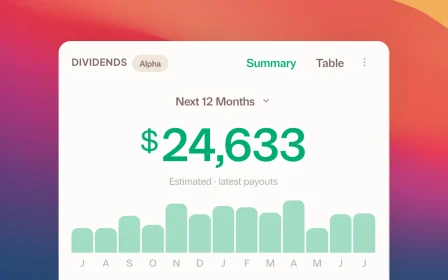
Greenline flags likely dividends for you to confirm, so you can see what’s coming in alongside everything else in your portfolio.
See your dividend income across all your accounts It's the sort of thing we built Greenline for, if that'd ever be useful to you.
More in The Fine Print

What you're actually paying in investment fees

What to do after maxing your registered accounts

DIVY ETF: what DIVY.TO is, what it holds, and how it works

How to read your brokerage statement
Investment tax in Canada, simplified

How to set up a DRIP at your Canadian brokerage
What you're actually paying in investment fees
Too many investors have no idea what they're paying in fees. MERs, trading commissions, currency conversion. Here's where your money is quietly going.
What to do after maxing your registered accounts
DIVY ETF: what DIVY.TO is, what it holds, and how it works
How to read your brokerage statement
Investment tax in Canada, simplified