

Home market bias: over-investing in Canada


Part 4 of 9
This article is part of our Going deeper series.
Short answer: Canada makes up about 3% of global stock market value, but the average Canadian investor holds 50% to 60% of their equities in Canadian stocks. Some home bias is fine for tax efficiency, but heavy concentration in the TSX means an over-allocation to financials and energy and a single-country bet.
When I started investing, almost everything I owned was Canadian. Bank stocks, energy companies, a couple of telecoms. I told myself it made sense because I “knew these companies.” I banked with them. I filled up at their gas stations. I paid their phone bills. That familiarity felt like an edge.
It wasn’t. Knowing a company’s products doesn’t mean you understand its stock price, its competitive position, or its long-term outlook. What I actually had was a concentrated bet on one of the smallest developed stock markets in the world, and I didn’t even realize it.
This isn’t financial advice or a recommendation for any specific allocation. Geographic diversification depends on your own situation, goals, and tax circumstances. But the patterns here are worth understanding.
How small is Canada’s market, really?
Canada’s stock market represents roughly 3% of global equity market capitalization. The United States is around 45-50%. International developed markets (Europe, Japan, Australia, and others) make up another 30-35%. Emerging markets fill in the rest.
If you built a portfolio that perfectly mirrored the global stock market, only 3 cents of every dollar would be in Canadian companies. But studies consistently show the average Canadian investor holds 50-60% of their equity portfolio in Canadian stocks. That’s more than 15 times the global weight.
This isn’t unique to Canada. Investors in every country tend to overweight their home market. Americans do it, Japanese investors do it, Australians do it. Researchers call it “home market bias,” and it’s one of the most well-documented patterns in investing.
Why we do it
Home market bias isn’t irrational. Or rather, it’s understandable even if it’s not optimal. A few things drive it:
Familiarity. You recognize the names on the TSX. You see Royal Bank branches on every corner. You watch Shopify in the news. Investing in companies you’ve heard of feels safer than investing in companies you haven’t, even though the feeling has nothing to do with actual investment risk.
Dividends. Canadian companies, especially the banks and telecoms, are known for paying reliable dividends. And in a non-registered account, Canadian dividends get preferential tax treatment through the dividend tax credit. This is a real advantage, not just a feeling. It makes holding some Canadian dividend payers in a taxable account a legitimate tax strategy.
Currency. If your expenses are in Canadian dollars, holding Canadian investments means no currency conversion and no foreign exchange risk. Your returns are already in the currency you spend. That matters, though perhaps less than most people think over long time horizons.
Simplicity. It’s just easier. You open a Canadian brokerage account, you see Canadian-listed stocks, you buy them. No thinking about foreign withholding taxes, no worrying about T1135 filing requirements, no currency headaches.
The concentration problem
The Canadian stock market is heavily concentrated in three sectors: financials (banks and insurance), energy (oil and gas), and materials (mining). Together, these make up roughly 50-60% of the TSX Composite Index. Technology, healthcare, and consumer goods, sectors that dominate the U.S. and global markets, are a much smaller slice.
When you hold mostly Canadian stocks, you’re making an implicit bet that banks, oil companies, and miners will continue to perform well. In some years, that bet pays off beautifully. In others, it doesn’t. The resource-heavy nature of the TSX means it tends to move differently from global markets, which can be a drag during periods when technology or healthcare leads global growth.
Between 2010 and 2020, the S&P 500 returned roughly 190% in Canadian dollar terms. The TSX returned roughly 65% over the same period. That’s not a small gap. A Canadian investor who held 100% Canadian equities during that decade missed out on significant global growth. Past performance isn’t a guarantee of future results, but the lesson is about diversification, not about which country is “better.”
What good diversification looks like
There’s no single “right” allocation. But most portfolio managers and researchers suggest that Canadian investors should hold somewhere between 20-30% in Canadian equities, with the rest spread across U.S., international developed, and emerging markets.
Why not just go to 3% to match the global weight? Because those real advantages, the dividend tax credit, the currency alignment, the simplicity, do justify some home tilt. The question is how much tilt, and 50-60% is almost certainly more than the advantages warrant.
A portfolio with 25% Canada, 45% U.S., 25% international developed, and 5% emerging markets is a reasonable, well-diversified starting point. Different funds and advisors will land on different numbers, and that’s fine. The point isn’t to get the exact percentages perfect. It’s to make sure you’re not accidentally putting most of your money into 3% of the world’s companies.
How all-in-one ETFs handle this
This is one of the best arguments for all-in-one ETFs like XEQT or VEQT. They make the diversification decision for you. XEQT holds about 24% in Canada, 46% in the U.S., and the rest spread internationally. VEQT has a similar breakdown with slightly different weights.
You could debate whether 24% in Canada is too much or too little, but it’s a defensible, well-thought-out allocation designed by portfolio strategists. It’s certainly better than the 50-60% that many Canadians end up with when they pick investments on their own.
If you’re managing your own portfolio, the all-in-one approach solves the diversification problem without you having to think about it. The fund rebalances automatically. You just keep buying.
One fund takes the opposite approach. CAGX, an Avantis CIBC fund filed in July 2026 and not yet trading, targets about 3% Canadian equity, which is roughly Canada’s actual share of global market value. That’s the no-home-bias position taken literally. It removes the concentration problem described above, and it also gives up the dividend tax credit benefit and the currency matching that make some Canadian tilt reasonable. Worth knowing the option exists, and worth understanding both sides before treating it as the obviously correct answer.
When a Canadian tilt does make sense
Home market bias isn’t always a mistake. There are times when tilting toward Canada is a conscious, defensible choice:
In a non-registered account, where the Canadian dividend tax credit gives you a real tax edge. If you’re in a lower tax bracket, eligible Canadian dividends can be taxed at close to zero. That’s not a bias, that’s tax planning.
If you’re approaching retirement and want income in Canadian dollars without currency fluctuations. Predictable cash flow matters more when you’re spending down a portfolio instead of building one.
If you have a small portfolio and want to keep things simple. One or two Canadian ETFs are easier to manage than a multi-fund global allocation. The simplicity benefit has real value if it keeps you investing instead of procrastinating.
The key distinction is between intentional tilting and unintentional concentration. If you’ve thought about it and decided that 30-40% in Canada works for your situation, that’s a strategy. If you’re holding 70% Canadian stocks because you didn’t think about it at all, that’s a blind spot.
My own realization
When I finally looked at my portfolio composition properly, I was surprised by how Canada-heavy it was. Almost everything I owned was a bank, an energy company, or a telecom. I thought I was diversified because I held different names. But they were all Canadian, all in the same few sectors, all moving in the same direction when something went wrong in the Canadian economy.
The shift toward global diversification wasn’t dramatic. I didn’t sell everything overnight. I just started directing new contributions into broader funds and let the portfolio naturally rebalance over time. The mental shift was harder than the actual changes. It felt uncomfortable putting money into companies I’d never heard of, in countries I’d never visited. But that discomfort was the whole point. If your portfolio only contains things you recognize, it almost certainly doesn’t contain enough.
If your portfolio only contains things you recognize, it almost certainly doesn’t contain enough.
If the fix in your case is adding everything outside North America in one holding, XINT covers developed and emerging markets ex-Canada and ex-U.S. in a single ticker.
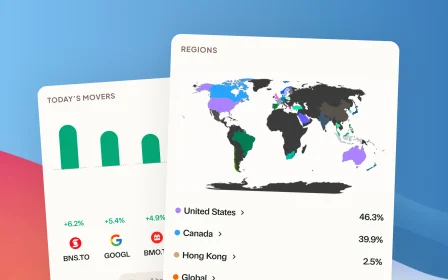
See your geographic breakdown and find out how diversified you really are Seeing it all in one place is what we built Greenline to do, if you ever want a hand.
More in The Long Game

Currency-hedged ETFs: do you actually need them?
XINT ETF: the iShares Core MSCI All-International Equity Index ETF

Just buy XEQT? The one-ETF strategy explained

CACE vs CAGE: the Canadian sleeve vs the all-in-one Avantis fund

T1135: the foreign income form you might miss
Currency-hedged ETFs: do you actually need them?
Are you losing money to currency swings without realizing it? Some ETFs hedge that out, others don't. Here's how to tell and why the answer for most Canadians is simple.
XINT ETF: the iShares Core MSCI All-International Equity Index ETF
Just buy XEQT? The one-ETF strategy explained
CACE vs CAGE: the Canadian sleeve vs the all-in-one Avantis fund