

T1135: the foreign income form you might miss


Part 5 of 6
This article is part of our Taxes and your portfolio series.
Short answer: If you held more than $100,000 CAD in “specified foreign property” at any point in the year (including U.S. stocks, U.S.-listed ETFs, and most non-Canadian investments held in non-registered accounts), you must file Form T1135 with your tax return. Holdings inside a TFSA, RRSP, or RRIF are excluded.
There is a CRA form that applies to a growing number of Canadian investors, and it rarely comes up in conversation. It’s called the T1135, Foreign Income Verification Statement. If you held more than $100,000 CAD in “specified foreign property” at any point during the year, you’re required to file it. Miss it, and the penalties can be steep.
I found out about this form after the fact, which seems to be a common experience. I was reading a tax forum, deep in a thread about something else entirely, when someone casually mentioned it. My first thought was, “Wait. My U.S. stocks count as foreign property?” Yes. They do.
This isn’t tax advice. Tax rules change, thresholds can shift, and your situation may have details that make a difference. Talk to a tax professional before making any filing decisions. But here’s what’s worth knowing.
What counts as “specified foreign property”
The list is broader than you might expect. Specified foreign property includes:
- Stocks listed on foreign exchanges (including U.S. stocks like Apple, Google, Amazon)
- U.S.-listed ETFs (like VTI, VOO, QQQ)
- Foreign bonds and debt obligations
- Foreign bank accounts
- Foreign real estate held for investment (not personal vacation property)
- Interests in non-resident trusts and partnerships
The key word is “foreign.” Any property that exists outside Canada counts toward the $100,000 threshold. And the threshold is based on cost amount (roughly what you paid), not current market value. So even if your U.S. holdings dropped in value, you might still be above the line based on what you originally invested.
The big exception: registered accounts
Here’s the part that catches people off guard in the other direction. Foreign property held inside registered accounts, your TFSA, RRSP, FHSA, RESP, RDSP, doesn’t count toward the T1135 threshold. The CRA doesn’t consider those as “specified foreign property” because the accounts themselves are Canadian-registered.
So if you hold $80,000 worth of U.S. stocks in your RRSP and $30,000 of U.S. stocks in a non-registered account, your T1135-relevant total is $30,000, well below the $100,000 threshold. You’re fine.
But if you have $120,000 in U.S. stocks in a non-registered account, you need to file. Even if you have zero foreign holdings in your registered accounts.
Canadian-listed ETFs that hold foreign assets
This is where it gets interesting. If you own a Canadian-listed ETF like XEQT or VEQT that holds U.S. and international stocks inside it, that ETF does not count as foreign property. It’s listed on the TSX. It’s a Canadian fund. The fact that it holds foreign investments internally doesn’t make it “specified foreign property” for T1135 purposes.
But if you own VTI (a U.S.-listed ETF) directly in a non-registered account, that does count. The difference is where the fund itself is listed, not what it holds inside.
This distinction matters a lot. Many Canadian investors specifically choose Canadian-listed equivalents (like VFV instead of VOO, or XUU instead of VTI) partly to stay below the T1135 threshold. Something to think about when choosing your investments.
The two reporting levels
The T1135 has two methods:
| Method | When to use | What you report |
|---|---|---|
| Simplified | Total cost was over $100,000 but under $250,000 throughout the year | Check boxes for property types, country, income range. Fairly painless. |
| Detailed | Total cost was $250,000 or more at any time during the year | Specific details for each property: cost, income earned, gains/losses. More work. |
The simplified method is quick. Most self-directed investors who cross the $100,000 threshold will fall into this category. It takes maybe 15 minutes if you have your numbers ready.
Penalties for not filing
The penalties are steeper than you’d expect. The exact amounts depend on your situation and can change, so check the CRA’s current penalty schedule to be sure. But the ballpark: late filing can cost you $25 per day. Ignore a demand to file and it gets significantly worse, potentially hundreds per month. Gross negligence carries its own penalties on top of that. And they can go back multiple years.
For a form that takes 15 minutes, none of this is worth finding out firsthand. If you’re anywhere near the threshold, check your numbers and file.
How to know if you’re close
Add up the cost amount of all foreign property held in non-registered accounts. Not the market value, the cost, what you actually paid. Include foreign stocks, U.S.-listed ETFs, foreign bank accounts. Exclude anything in a TFSA, RRSP, FHSA, or other registered account.
If you’re hovering near $100,000, it’s worth being especially careful. The threshold is based on the maximum at any point during the year. If your foreign holdings briefly crossed $100,000 in July and then dropped back below in September, you still need to file.
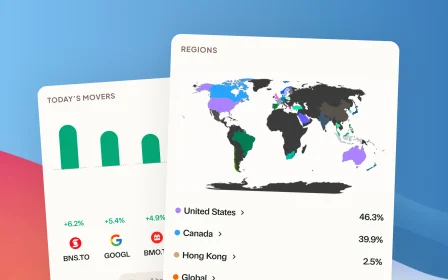
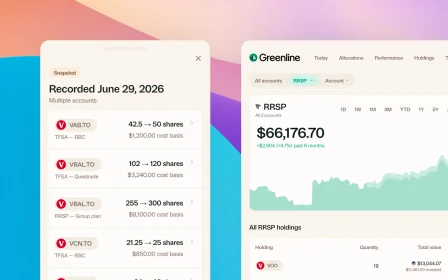
Greenline shows you your holdings by account type and geography, which makes it easier to see how much foreign property you’re holding and where, especially when tax season rolls around.
The fees, the returns, the details buried in your statements add up, once you can actually see them in one place. Seeing it all in one place is what we built Greenline to do, if you ever want a hand.
More in The Fine Print

Norbert's Gambit: the Canadian currency hack

Home market bias: over-investing in Canada

Currency-hedged ETFs: do you actually need them?

Investment tax in Canada, simplified
Norbert's Gambit: the Canadian currency hack
Norbert's Gambit converts CAD to USD near mid-market, not a 1.5% to 2.5% FX markup. How it works and which brokers support it, Wealthsimple included in 2026.
Home market bias: over-investing in Canada
Currency-hedged ETFs: do you actually need them?
Are you losing money to currency swings without realizing it? Some ETFs hedge that out, others don't. Here's how to tell and why the answer for most Canadians is simple.