How to pick ETFs in Canada


Part 1 of 5
This article is part of our Beyond the basics series.
Short answer: When picking an ETF in Canada, look at what it actually holds (not the name), the MER, the index it tracks, the assets under management (for liquidity), and how it fits with what you already own. Cheap, broad, and boring usually wins.
Search “best ETFs Canada” and you’ll get a dozen listicles. They all look authoritative. They all have slightly different picks. And if you check the same sites a year later, the lists have changed. The ETFs that were “must-buys” last January are quietly replaced by new ones, often from providers who happen to be advertising on that same site.
I’m not saying those lists are useless. Some of them contain perfectly good funds. But following a list is not the same as understanding what you’re buying. And if you don’t know how to evaluate an ETF yourself, you’ll never know whether the one someone recommended actually fits your situation or whether it was just the flavour of the month.
None of this is financial advice. ETF compositions, fees, and performance change over time. This is a framework for thinking about how to evaluate them, not a recommendation to buy anything specific.
Start with what it actually holds
This sounds obvious, but most people skip it. They hear a ticker symbol, see a one-year return number, and buy it. They never look at what’s inside.
Every ETF has a holdings page, usually on the fund provider’s website. It tells you exactly which stocks or bonds the ETF owns, and in what proportions. An ETF called “Canadian Dividend” might hold 60% financials. An ETF called “Global Growth” might be 50% U.S. tech. The name tells you very little. The holdings tell you everything.
Before you buy, ask yourself: does what this ETF holds match what I actually want in my portfolio? If you already own a lot of Canadian banks individually and then buy a “Canadian Dividend ETF” that’s heavily weighted toward banks, you’ve just doubled down on the same bet without realizing it.
The MER: the fee that never sleeps
The Management Expense Ratio (MER) is the annual fee the fund charges, expressed as a percentage of your investment. It’s deducted automatically from the fund’s value. You never see a bill. Your returns are just a little lower than they otherwise would be.
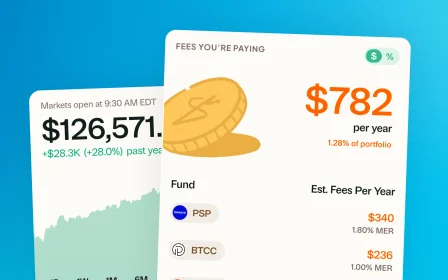
Here’s where small numbers get deceptive. An MER of 0.05% and an MER of 0.75% look almost identical on a page. But 0.75% is fifteen times more than 0.05%. On a $100,000 portfolio over 25 years, that difference costs you tens of thousands of dollars. The full breakdown of how fees compound is worth reading if you haven’t already.
For broad market index ETFs, you should expect MERs between 0.03% and 0.25%. If you’re seeing an MER above 0.50% on an index fund, something is off. Either it’s not really a passive index fund, or you’re paying too much. For all-in-one ETFs like XEQT or VEQT, an MER around 0.20% is standard and reasonable. Factor-tilted alternatives like CAGE.TO sit a few basis points higher because the strategy is more involved than cap-weighted indexing.
Actively managed ETFs will charge more, often between 0.50% and 1.00%. That’s not inherently bad, but you should be aware that not all ETFs are passive, and higher fees need to be justified by something the fund is doing that a cheaper index fund isn’t.
Assets under management and liquidity
AUM (Assets Under Management) tells you how much money is invested in the fund. Larger funds tend to have tighter bid-ask spreads, which means you pay less in hidden trading costs when you buy or sell. A fund with $5 billion in AUM will generally trade more efficiently than one with $20 million.
This doesn’t mean small funds are bad. But if you’re choosing between two ETFs that hold similar things, the one with significantly more AUM will usually be cheaper to trade. For very small funds, there’s also a risk that the provider could close the fund if it’s not economically viable to keep running it. That doesn’t mean you lose your money, but it does create a taxable event and a hassle.
A simple check: look at the average daily trading volume. If an ETF trades millions of shares per day, you’re fine. If it trades a few hundred, be cautious.
Tracking error
If an ETF claims to track the S&P 500, you’d expect it to match the S&P 500’s return. In practice, there’s almost always a small gap. That gap is called tracking error.
Some tracking error comes from the MER itself, since the fund deducts its fee from the returns. Some comes from how the fund replicates the index (does it hold every stock in the index, or does it use sampling?). Some comes from cash drag, which is the small amount of uninvested cash the fund holds at any given time.
For most major index ETFs, tracking error is tiny and not worth worrying about. But if you’re comparing two ETFs that track the same index, the one with lower tracking error is doing a better job of delivering what it promises. You can find this data in the ETF’s annual report or on comparison sites.
Distributions and tax efficiency
ETFs can pay distributions in the form of dividends, interest, capital gains, or return of capital. How often they pay (monthly, quarterly, annually) and what type of income they distribute affects your tax bill, especially in a non-registered account.
In a TFSA or RRSP, this mostly doesn’t matter. The account shelters you from tax on distributions. But in a non-registered account, an ETF that distributes a lot of capital gains can create a tax hit even if you haven’t sold a single share.
Some ETFs are structured to minimize distributions, which makes them more tax-efficient. This is a factor worth considering if you’re investing outside registered accounts. For ETFs vs. mutual funds, tax efficiency is one of the areas where ETFs tend to have an edge.
How to read an ETF facts sheet
Every ETF sold in Canada is required to publish an ETF Facts document. It’s a two-page summary that includes:
The fund’s investment objective (what it’s trying to do). The top holdings (what it actually owns). The MER and trading expense ratio. Performance history. Risk rating. Distribution information.
This document is designed to be readable by regular people, not just financial professionals. Before you buy any ETF, read its ETF Facts sheet. It takes two minutes and will tell you more than any listicle ever could. You can find it on the fund provider’s website or on your brokerage platform.
The honest admission
For a lot of people, all of this evaluation isn’t necessary. If you buy a single all-in-one ETF from a reputable provider, you’ve already got broad diversification, low fees, automatic rebalancing, and solid liquidity. You don’t need to compare tracking errors or analyse distribution types. The whole point of an all-in-one ETF is that someone else has already made those decisions for you.
The people who need to pick and compare individual ETFs are those building multi-ETF portfolios for tax optimization across different account types, or those who want specific sector or geographic exposure beyond what an all-in-one fund provides. If that’s you, the criteria above will help. If it’s not, don’t feel bad about keeping things simple. Simple works.
The “best ETF” isn’t the one with the highest return last year. It’s the one that matches what you’re trying to build, at a cost you understand, from a provider you trust. Everything else is noise.
The “best ETF” isn’t the one with the highest return last year. It’s the one that matches what you’re trying to build, at a cost you understand, from a provider you trust.
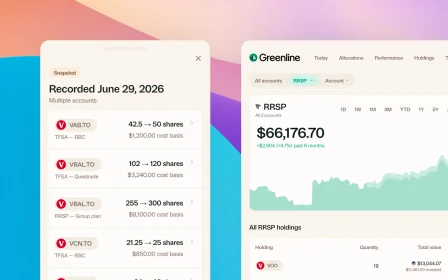
Greenline lets you see exactly what your ETFs hold and how they fit together across your accounts, so you can evaluate your overall portfolio instead of looking at each fund in isolation.
Choosing a fund is the fun part. Keeping track of what you actually hold, across every account, is the part that tends to slip. Seeing it all in one place is what we built Greenline to do, if you ever want a hand.
More in DIY Investing

Just buy XEQT? The one-ETF strategy explained

Not all ETFs are created equal

What you're actually paying in investment fees
Building a portfolio that doesn't need babysitting

Individual stocks vs ETFs: how to think about both
Just buy XEQT? The one-ETF strategy explained
'Just buy XEQT' has become the go-to answer in Canadian investing. Here's what XEQT actually holds, why it works for most people, and when you want more.
Not all ETFs are created equal
What you're actually paying in investment fees
Building a portfolio that doesn't need babysitting