What your brokerage app isn't telling you


The quick take: Brokerage apps usually show your balance and a dollar change, but skip the context that matters: your real return separated from contributions, your fee drag, your full allocation across accounts, and how you compare to a benchmark. The number you see is the start of the picture, not the whole one.
I logged into my brokerage app on a Tuesday morning and saw a notification. “Your account is up $1,200.” Nice. I felt good for about three seconds. Then the questions started. Is that a lot? On what time frame? Is that a 2% return or a 10% return? How does it compare to the market? Did fees eat into it? The app didn’t say. It just showed me a green number and expected me to feel something positive.
That’s when I realized my brokerage was doing exactly what it was designed to do. Show me just enough to feel fine, but not enough to actually understand.
Your brokerage app is designed to show you just enough to feel fine, but not enough to actually understand.
This isn’t financial advice, and I’m not here to tell you what to invest in. But I do think it’s worth understanding the gaps in what your brokerage shows you, because those gaps affect how you think about your money.
The dollar change problem
Most brokerage apps lead with a dollar amount. Your portfolio is up $1,200. Your account gained $3,400 this year. It sounds concrete and satisfying.
But $1,200 on a $12,000 portfolio is a 10% return. That’s great. $1,200 on a $120,000 portfolio is 1%. That’s barely keeping up with inflation. Same dollar number. Completely different story.
Dollar changes are easy to display and easy to feel good about. They’re also nearly useless without context. Your portfolio could be trailing the market by a wide margin and you’d never know, because $1,200 still sounds like $1,200.
Some apps do show percentage returns if you dig into the settings or tap through a few screens. But the default view, the one you see when you open the app, almost always leads with dollars. That’s not an accident.
Contributions get mixed in
Here’s one that catches people off guard. You contribute $5,000 to your TFSA in February. At the end of the month, your account is up $5,400. That feels like a win. But wait. Did your investments grow by $5,400, or did you deposit $5,000 and your investments grew by $400?
Most brokerage apps don’t separate your contributions from your investment returns in any obvious way. The balance just goes up, and your brain fills in the story it wants to hear.
I’ve talked to people who thought they were up 15% for the year when most of the growth was just money they deposited. That’s not a small misunderstanding. It completely changes whether your investment strategy is working or not. If you can’t tell the difference between “my investments grew” and “I added more money,” you can’t make informed decisions about what to do next.
No benchmark comparison
This is the big one. Your brokerage will happily show you that your portfolio returned 8% last year. What it will never show you is that a single, boring, all-in-one ETF like XEQT returned 14% over the same period.
That comparison is the most useful piece of context you could have. It answers the question every investor should be asking: am I doing better or worse than a simple, low-cost alternative?
But brokerages aren’t going to volunteer that information. If you’re in their managed products or their in-house funds, showing you a benchmark that outperformed them isn’t exactly good for business. So they just don’t show it.
You’re left with a number that exists in a vacuum. 8% sounds good until you learn the market did 14%. Then it sounds like a problem. That context matters.
The multi-account blind spot
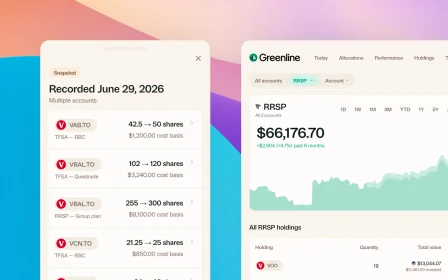
Most people don’t have everything in one place. Maybe you have a TFSA at one brokerage, an RRSP at another, a non-registered account somewhere else, and a workplace pension you log into once a year. Each of those platforms only shows you what’s inside their walls.
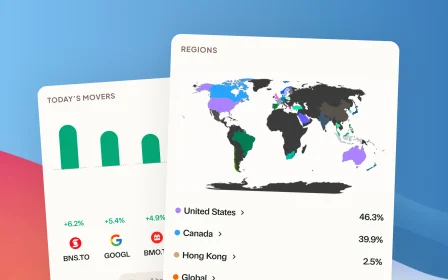
Your overall asset allocation across everything? Not their problem. Your total equity exposure? Not their concern. Whether you’re accidentally holding 40% Canadian banks because every account has a little bit of the same thing? They have no idea, and no way to tell you.
This is the investment equivalent of tracking your spending on three different apps and never adding it all up. Each view is technically accurate. None of them give you the full picture.
For a lot of people, the most important financial question isn’t “how is this one account doing?” It’s “how is everything doing, together?” And no single brokerage can answer that.
Fees are hidden in plain sight
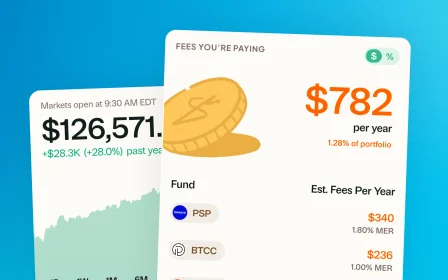
If I charged you $1,000 a year, you’d want to know what you were getting for it. But that’s roughly what a 1% MER costs on a $100,000 portfolio, and most people have no idea they’re paying it.
That’s because the fee gets deducted from the fund’s price before you ever see it. There’s no line item. No charge on your statement. No notification. The fund just grows a little less than it would have without the fee, and you never see the difference because you never see what could have been.
Your brokerage shows you a return of 7%. What it doesn’t tell you is that the fund actually earned 8%, and 1% went to fees. Over 20 years, that hidden 1% can add up to tens of thousands of dollars. It’s real money that quietly disappeared, and the app was never going to mention it.
I’ve written more about how these fees work here, but the short version is: they’re designed to be invisible. And they are.
The full picture is a different job
None of this means brokerages are doing anything wrong. They’re good at what they do. They hold your money, execute your trades, and keep your accounts secure. That’s their job.
But giving you the full picture of your financial life, separating contributions from returns, comparing your performance to a benchmark, showing you your allocation across every account, making fees visible, that’s a different job entirely.
It’s not that they’re hiding things from you. It’s that the things you actually need to make good decisions aren’t things they were built to provide. Your brokerage is a tool for transactions. Understanding your portfolio is a separate problem. And once you see the gaps, it’s hard to unsee them.
See what your brokerage doesn't show you If you ever want everything you own in one view, that's what Greenline is for.
More in The Long Game

Do you know how your portfolio is actually doing?

Why your investment returns are so confusing
Small percentages, big differences
Do you know how your portfolio is actually doing?
Most investors can't answer this. Your brokerage shows a number, but it might not mean what you think. Here's what's really going on.
Why your investment returns are so confusing