Canadian Account Types Greenline Supports
Greenline tracks every major Canadian investment account type used by self-directed investors. This page lists each account, the contribution rules and tax treatment, and how Greenline handles it.
Numbers reflect 2026 limits. For tax planning, consult your accountant or your CRA Notice of Assessment for your exact contribution room.
TFSA Tax-Free Savings Account
A TFSA is a registered account where investments grow and can be withdrawn completely tax-free. You contribute with after-tax dollars, get no deduction, and pay no tax when you take money out. The 2026 annual limit is $7,000. If you were 18 or older in 2009 and have never contributed, your cumulative room is $109,000. Withdrawals add back to your room the following year.
In Greenline
Greenline tracks your TFSA contributions, holdings, and growth alongside your other accounts. You can record the contribution room you currently have, and Greenline counts contributions over time so you can see how close you are to your limit.
Read the TFSA glossary entry →
RRSP Registered Retirement Savings Plan
An RRSP is a registered account designed to help you save for retirement. Contributions are tax-deductible, investments grow tax-deferred inside the account, and withdrawals are taxed as income. Your contribution limit is 18% of your previous year's earned income, up to the 2026 annual maximum of $33,810. Unused room carries forward. The exact limit appears on your CRA Notice of Assessment.
In Greenline
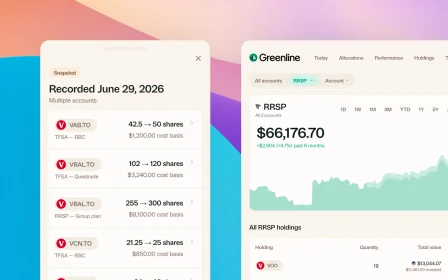
Greenline shows your RRSP holdings, performance, and fees alongside every other account. Track contributions, see what you hold across registered and non-registered accounts in one view, and understand your real return after fees.
Read the RRSP glossary entry →
FHSA First Home Savings Account
The FHSA combines features of a TFSA and an RRSP. Contributions are tax-deductible like an RRSP, and qualifying withdrawals to buy a first home are tax-free like a TFSA. The annual limit is $8,000, with a lifetime maximum of $40,000. Unused room carries forward, but only up to $8,000 per year. The account can stay open for up to 15 years.
In Greenline
Greenline tracks your FHSA holdings and contributions alongside the rest of your portfolio. You can see how your down payment savings are growing relative to other goals.
Read the FHSA glossary entry →
RESP Registered Education Savings Plan
An RESP is a registered account for saving for a child's post-secondary education. The biggest advantage is the Canada Education Savings Grant (CESG), which matches 20% of your contributions up to $500 per child per year, with a lifetime cap of $7,200 in grants per child. The lifetime contribution limit is $50,000 per child, with no annual contribution cap.
In Greenline
Greenline tracks RESP holdings and growth alongside your other accounts. You can see how the CESG and your contributions are compounding over time.
Read the RESP glossary entry →
RDSP Registered Disability Savings Plan
An RDSP helps Canadians who qualify for the Disability Tax Credit save for the future. The Canada Disability Savings Grant matches contributions up to 300% based on family income, with a maximum annual grant of $3,500 and a lifetime grant cap of $70,000. The Canada Disability Savings Bond adds up to $1,000 per year for lower-income beneficiaries, with a lifetime cap of $20,000. The lifetime contribution limit is $200,000.
In Greenline
Greenline tracks RDSP balances and holdings alongside your other accounts. Government grants and bonds count toward the account balance, and you can see the full picture in one view.
Read the RDSP glossary entry →
LIRA Locked-In Retirement Account
A LIRA holds money transferred from a former employer's pension plan. It works like an RRSP for growth, but the money is locked in. You generally cannot withdraw directly. At retirement you convert the LIRA into a Life Income Fund (LIF) or a similar income vehicle. Lock-in rules vary by province and by whether the pension was federally or provincially regulated.
In Greenline
Greenline tracks your LIRA holdings, performance, and allocation alongside your other accounts so you can see your full retirement picture in one place.
Read the LIRA glossary entry →
LIF Life Income Fund
A LIF is what you convert a LIRA into when you start drawing retirement income. It has both an annual minimum and an annual maximum withdrawal. The minimum follows the same formula as a RRIF, based on age and balance. The maximum is set by federal or provincial rules and prevents the account from being drained too quickly. You must convert a LIRA to a LIF by December 31 of the year you turn 71.
In Greenline
Greenline tracks your LIF balance, withdrawals, and remaining holdings so you can plan around the minimum and maximum each year.
Read the LIF glossary entry →
RRIF Registered Retirement Income Fund
A RRIF is what your RRSP becomes when you start taking money out. By December 31 of the year you turn 71, your RRSP must be converted to a RRIF, used to buy an annuity, or withdrawn entirely. Most people choose the RRIF. There is a minimum required withdrawal each year (around 5.28% at age 71, rising with age), and withdrawals are taxed as income.
In Greenline
Greenline tracks your RRIF balance, holdings, and withdrawals across years so you can see how your retirement income is being drawn down.
Read the RRIF glossary entry →
Spousal RRSP Spousal Registered Retirement Savings Plan
A Spousal RRSP belongs to your spouse, but you make the contributions and you get the deduction. The money grows in your spouse's account and is taxed as their income when withdrawn. The contribution comes from your own RRSP room. The main use case is income splitting between partners with different tax brackets. Note the three-year attribution rule: if your spouse withdraws within three years of your most recent contribution, the withdrawal is taxed as your income.
In Greenline
Greenline tracks Spousal RRSPs alongside regular RRSPs so you and your partner can see the full household picture.
Read the Spousal RRSP glossary entry →
Group RRSP Group Registered Retirement Savings Plan
A Group RRSP is an employer-sponsored RRSP that lets you contribute through payroll deductions, often with an employer match. Contributions reduce your taxable income immediately, the same way an individual RRSP contribution does. Some employers also offer a Defined Contribution Pension Plan (DCPP) alongside or instead. Both share contribution room with your personal RRSP.
In Greenline
Greenline tracks your Group RRSP balance and holdings alongside your personal accounts. Employer matches show up the same way as your own contributions.
Read the Group RRSP glossary entry →
Non-registered Non-Registered (Taxable) Account
A non-registered account is a standard investment account with no special tax treatment. You owe tax each year on dividends, interest, and realized capital gains. Canadian dividends qualify for the dividend tax credit. Capital gains are taxed at 50% inclusion on the first $250,000 in gains per year. There are no contribution limits and no withdrawal restrictions.
In Greenline
Greenline tracks non-registered holdings, dividends, and adjusted cost base so you have what you need at tax time. ACB calculations follow Canadian rules.
Read the Non-registered glossary entry →
Margin Margin Account
A margin account is a non-registered account where the brokerage lets you borrow money against your holdings to buy more investments. Borrowing magnifies both gains and losses, and a sharp drop in your investments can trigger a margin call that forces you to deposit more cash or sell. Margin accounts carry real risk and are usually held by experienced investors with a specific strategy.
In Greenline
Greenline tracks margin account balances, holdings, and performance the same way it tracks any non-registered account.
Read the Margin glossary entry →
Cash Cash Account
A cash account is a non-registered investment account that does not allow margin borrowing. You can only buy what you can pay for in full. It works the same way as any taxable account from a tax perspective: dividends, interest, and capital gains are taxable each year.
In Greenline
Greenline tracks cash account holdings alongside every other account in your portfolio.
Read the Cash glossary entry →
Corporate Corporate Investment Account
A corporate investment account holds investments owned by a Canadian-controlled private corporation (CCPC), often used by incorporated professionals or business owners to invest retained earnings. Tax treatment is more complex than a personal account: passive investment income inside a corporation is taxed at high rates, with refundable taxes that come back to the shareholder when dividends are paid out.
In Greenline
Greenline supports corporate accounts at a basic level. You can track holdings, balances, and performance the same way as a personal account. Corporate-specific tax features like passive investment income tracking and integration with corporate tax filings are not built in. Consult your accountant for tax planning.
What "tracking" actually means in Greenline
For every account type above, you can upload statements (PDF, CSV, or screenshots) from your brokerage, and Greenline organizes the holdings, contributions, and balances. No bank linking. No third-party aggregator. Your bank credentials stay with you.
Contribution room tracking starts from the room you tell Greenline you have today. From there, it counts contributions over time. Greenline does not connect to the CRA, so room from past years comes from your CRA My Account or your most recent Notice of Assessment.
Mutual fund balances are updated manually at this time, which most people do monthly or quarterly when a statement arrives. Stock and ETF prices update daily.
The point of supporting all of them
Most Canadians end up holding more than one account type. A TFSA at one brokerage. An RRSP at the bank. Maybe an FHSA they opened recently. A Group RRSP through work. Maybe a non-registered account once the registered ones are full.
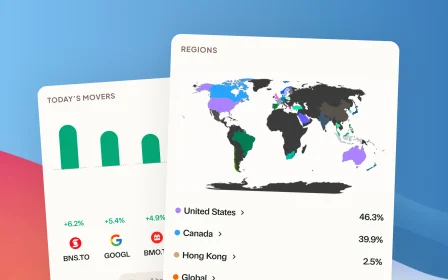
Each brokerage shows you what you hold inside that brokerage. None of them show you the full picture. Greenline does. You see your total net worth, your full allocation across regions and sectors, what you are paying in fees across every fund, and how each account is performing relative to the others.
That is why supporting every Canadian account type matters. The value is in the combination, not any single account.
See your accounts in one dashboard
Free during beta. No credit card required.
Try it free