

Dividend
A payment companies make to shareholders from their profits, deposited directly into your account.
A dividend is a cash payment that a company sends to its shareholders. Not all companies pay dividends, but many established ones do. In Canada, the big banks, telecom companies, and utilities are well known for paying regular dividends.
If you own 100 shares of a company that pays a $1.00 annual dividend per share, you’ll receive $100 over the course of the year. That money either lands in your brokerage account as cash or gets automatically reinvested into more shares, depending on your settings.
The Canadian dividend tax credit
When you hold Canadian dividend-paying stocks in a regular (non-registered) account, you get a tax break called the dividend tax credit. Without getting into the math, it means you pay less tax on Canadian dividends than you would on the same amount of employment income or interest. This is one reason Canadian dividend stocks are popular with investors who have maxed out their TFSA and RRSP.
Inside a TFSA or RRSP, the tax treatment doesn’t matter because the account itself handles the tax sheltering.
Why it matters
Dividends are one of the two main ways investments make you money (the other being growth in the stock price). For some investors, the regular income from dividends feels more tangible than watching a stock price go up. There’s something concrete about seeing cash deposited into your account every quarter.
Just keep in mind that a high dividend isn’t always a good sign. Sometimes a company’s stock price has dropped sharply, which makes the dividend percentage look large. Always look at the full picture. For more on how dividends work in Canada, see our guide to Canadian dividends.
In Greenline
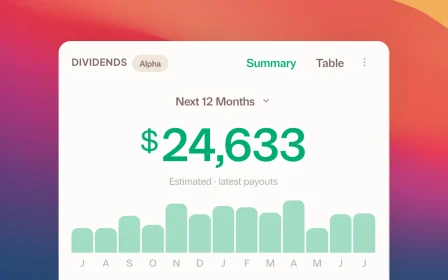
Greenline tracks your dividend income across all your holdings and accounts.

Your money stays where it is. Greenline just makes sense of it.
See all your accounts in one view:
See your full portfolio