
Diversification
Spreading your investments across different assets so a single bad outcome doesn't sink your entire portfolio.
Diversification means spreading your money across different investments so that you’re not relying on any single one to carry your portfolio. If one stock drops, the others can help cushion the blow. The idea is straightforward: don’t put all your eggs in one basket.
How it works
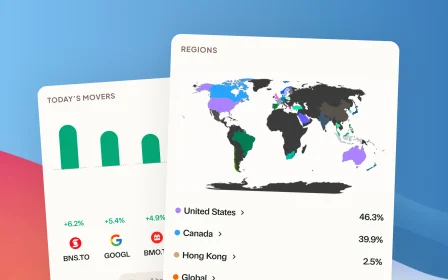
You can diversify in several ways. Across companies, by holding more than one stock. Across sectors, by investing in technology, banks, energy, healthcare, and so on. Across countries, by owning Canadian, US, and international investments. And across asset types, by holding a mix of stocks, bonds, and cash.
An index fund or broadly diversified ETF does a lot of this work for you. A single all-in-one ETF like XEQT or VGRO holds thousands of stocks across dozens of countries, giving you wide diversification in one purchase.
Why it matters
No one can predict which investment will perform best in any given year. Diversification reduces the risk that one bad pick or one bad sector wipes out a large portion of your portfolio.
That said, diversification doesn’t eliminate risk entirely. When the whole market drops, most investments tend to fall together. What it does protect against is concentrated risk, like having half your savings in a single stock that suddenly loses 40%.
Example
Imagine you have $40,000 invested entirely in one Canadian bank stock. If that stock drops 30% during a banking sector downturn, your portfolio falls to $28,000. Now imagine you had that same $40,000 spread across a global index ETF holding thousands of companies. If the banking sector drops 30% but makes up only 8% of the fund, the impact on your portfolio would be closer to a 2.4% dip, or about $960. Same money, very different outcome.
The goal isn’t to chase the highest return. It’s to build a portfolio that can handle bad surprises without falling apart. You give up the chance of hitting it big on one pick, but you also avoid the chance of losing it all on one. One common trap is overloading on Canadian stocks. Our home market bias guide explains why that happens and what to watch for.

Your money stays where it is. Greenline just makes sense of it.
See all your accounts in one view:
See your full portfolio