
CAGE vs ZEQT: how the new Avantis ETF stacks up against BMO's all-equity


Short answer: CAGE.TO is a new factor-tilted all-equity ETF from CIBC and Avantis, listed on the TSX in March 2026. ZEQT is BMO’s cap-weighted all-equity all-in-one, listed in January 2022. CAGE costs about 13 basis points more (0.28% management fee versus ZEQT’s 0.15%) and runs a deliberate value, size, and profitability tilt. ZEQT is a cleaner, lower-cost expression of “buy the global market by size” through BMO’s index ETFs. The choice is factor-tilted active versus cap-weighted indexing, not better versus worse.
ZEQT has been the quiet third option in the cap-weighted all-equity bucket. XEQT and VEQT get most of the attention, but ZEQT has built a credible track record since 2022 with one of the lowest MERs in the category. If you’re already holding it, you’ve made a deliberate call: simple, cap-weighted, low cost.
CAGE.TO is a different bet. Same one-ticker, all-equity, globally-diversified job, but with the Avantis factor methodology layered on top. The question for ZEQT holders is whether that’s worth paying for.
This is not financial advice. I’m sharing what I’ve learned from my own research, and your situation might be different from mine. Fund details change over time, so always check the latest disclosures before making a decision.
What CAGE actually is
CAGE.TO is an all-equity, globally diversified ETF listed on the TSX on March 18, 2026. CIBC manages the Canadian wrapper. Avantis Investors, a unit of American Century, designs and runs the strategy.
It’s structured as a fund-of-funds, holding a basket of underlying Avantis equity ETFs that cover U.S., international developed, emerging, and Canadian stocks. The headline numbers: 100% equities, unhedged, 0.28% management fee. The fund page doesn’t show an MER yet, but CIBC’s first interim report puts it at 0.35% annualized (period ended June 30, 2026).
The thing that makes CAGE different from ZEQT is the strategy. CAGE is rules-based active, with a deliberate tilt toward value, smaller, and profitability. ZEQT is broadly cap-weighted indexing.
For the deeper walkthrough of CAGE on its own, see the CAGE ETF explained guide.
What ZEQT is, briefly
ZEQT is BMO’s all-equity all-in-one ETF, listed on the TSX in January 2022. It’s a cap-weighted fund-of-funds that holds underlying BMO index ETFs across U.S., international developed, emerging, and Canadian stocks. BMO cut its management fee from 0.18% to 0.15% in June 2025, among the lowest of the major Canadian all-equity all-in-ones. Check the current ETF Facts for the full MER, which runs a little higher than the fee.
ZEQT’s pitch is straightforward: own the global market by size, in one ticker, at the lowest possible cost. It rebalances quarterly back to its target geographic weights. There’s no factor tilt, no active layer, no philosophy beyond “the market knows.”
If you already hold ZEQT, you probably picked it for some combination of three reasons: BMO is your bank, the MER is among the lowest in the category, or you wanted a slightly less crowded alternative to XEQT.
What “factor tilt” actually means
This is the part that matters. Without it, the comparison doesn’t make sense.
ZEQT owns the global stock market roughly in proportion to size. The biggest companies, like Apple, Microsoft, and Nvidia, get the biggest weights. CAGE owns a similar global universe but applies three deliberate tilts on top of cap weighting:
- Value. Cheaper companies relative to their fundamentals (book value, earnings, cash flow) get more weight than they would in a cap-weighted index.
- Size. Smaller companies get more weight than market cap alone would give them. Not “small-cap only,” just less concentration in megacaps.
- Profitability. Reliably profitable companies get included or overweighted. Chronically unprofitable ones get filtered or down-weighted.
The academic case goes back to Eugene Fama and Kenneth French in the early 1990s, with Robert Novy-Marx adding the profitability piece in 2013. Decades of data suggest these factors have rewarded patient investors over very long horizons.
The honest caveat: “very long” can mean a long time. Factor-tilted portfolios can underperform broad cap-weighted indices for ten years or more at a stretch. Anyone moving from ZEQT to CAGE has to be willing to sit through stretches of trailing the cap-weighted version without flinching.
CAGE vs ZEQT side-by-side
A row by row look. CAGE’s figures come from CIBC’s first interim report (June 30, 2026); ZEQT’s holdings from BMO’s fact sheet (September 30, 2026).
| Attribute | CAGE.TO | ZEQT.TO |
|---|---|---|
| Manager | CIBC, sub-advised by Avantis Investors | BMO Asset Management |
| Strategy | Rules-based active, factor-tilted | Cap-weighted indexing |
| Holdings approach | Fund-of-funds (underlying Avantis ETFs) | Fund-of-funds (underlying BMO index ETFs) |
| Headline cost | 0.28% mgmt fee; 0.35% annualized MER in first interim report | 0.15% mgmt fee |
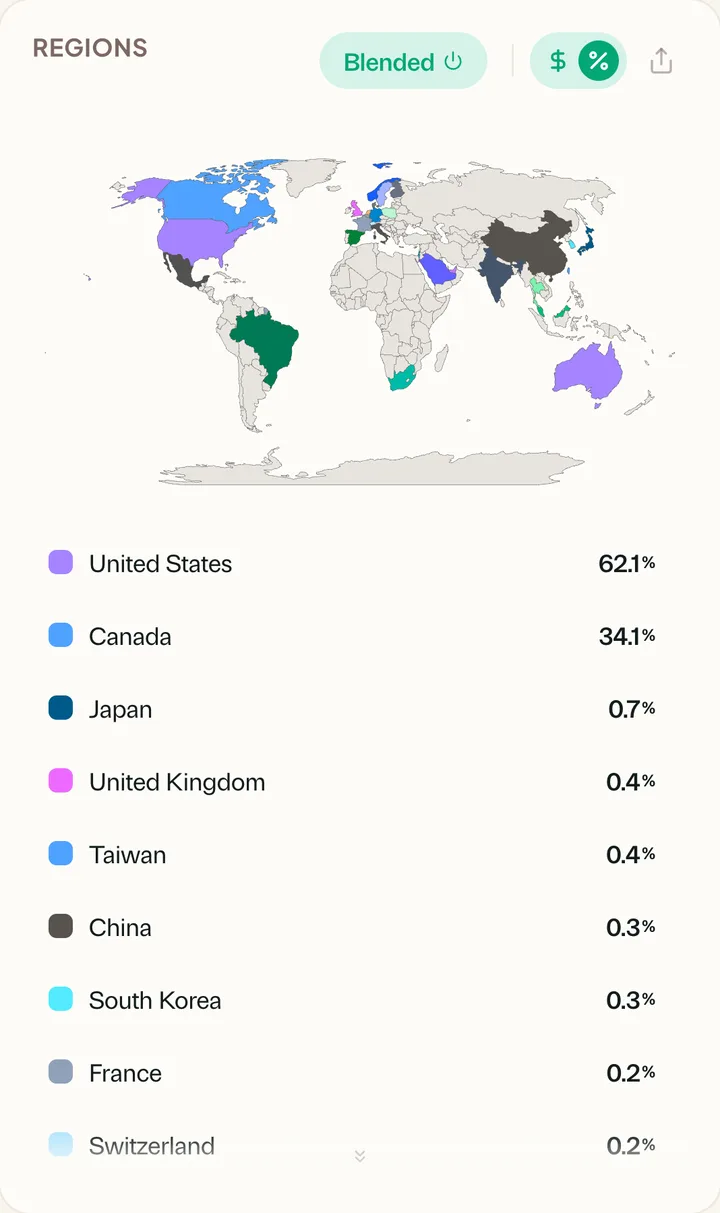
| Geographic split | 41.4% U.S., 29.5% Canada, 16.8% international developed, 7.4% global small cap value, 5.3% emerging | About 50% U.S. (S&P 500 plus mid and small cap), 24.2% Canada, 16.4% international developed, 9.4% emerging; rebalanced quarterly |
| Currency hedging | Unhedged | Unhedged |
| Distribution frequency | Quarterly | Quarterly |
| AUM | About $695M (June 30, 2026) | Multi-billion |
| Track record | Months of data | Listed since January 2022 |
| Listed since | March 18, 2026 | January 2022 |
The cost gap is about 13 basis points at the management fee level. That’s wider than CAGE’s gap to XEQT or VEQT, whose management fees are both 0.17% (as of September 2026).
What ZEQT does well
A few things worth naming directly, because they’re easy to take for granted:
- One of the lowest fees in the category. A 0.15% management fee is hard to argue with. Over decades, that compounds.
- Real track record now. Four years of trading data, including the 2022 drawdown and the 2024 recovery. The wrapper has been through real conditions.
- Genuinely simple. No factor decisions, no philosophy to defend, no underperformance windows to explain to yourself.
- BMO’s index ETFs underneath. ZSP, ZCN, ZEA, ZEM, plus small U.S. mid and small cap sleeves. Solid, well-run, large pools.
If “low cost, broad market, one ticker, leave me alone” is the brief, ZEQT delivers it as well as anything in the Canadian-listed universe.
What CAGE adds, if you believe in it
CAGE is the same job (one ticker, all equities, globally diversified) with a deliberate factor overlay. The pitch:
- Value, size, and profitability tilts that have historically rewarded patient investors over very long horizons.
- The Avantis methodology that’s built a strong reputation in the U.S. and on Rational Reminder.
- Canadian wrapper so you don’t need a USD account to hold the strategy.
Whether that’s worth 13 basis points more depends entirely on whether you believe in the factor thesis. If you do, CAGE expresses it cleanly. If you don’t, the extra cost is just extra cost.
Things to think about before switching
1. The strategy can underperform for years. Factor-tilted portfolios have stretches where they trail cap-weighted indices by a lot. That’s not a flaw, it’s how factor investing works. Anyone considering CAGE has to be honest about whether they’d still hold through five-plus years of trailing ZEQT.
2. CAGE is brand new in Canada. Avantis has a U.S. track record going back to 2019, but the Canadian-listed wrapper has only months of history. Distribution patterns, fund-of-funds tax flow, and how the wrapper handles flows are still being established.
3. The cost gap is real. 13 basis points compounds. On a $100,000 portfolio, that’s roughly $130 a year, every year. Over 30 years with growth, the cumulative drag is meaningful. The factor premium has to outweigh that drag for the trade to be worth it.
4. Tax behaviour will reveal itself over the first full year. CAGE is a fund-of-funds wrapping Canadian-listed Avantis CIBC ETFs. Foreign withholding tax, capital gains distributions, and how the layers interact in non-registered accounts won’t be fully visible until the first T3 cycle.
Frequently asked questions
Is CAGE better than ZEQT?
Different, not better. ZEQT is a cap-weighted index portfolio with a 0.15% management fee, one of the cheapest all-equity all-in-ones in Canada. CAGE is factor-tilted at a 0.28% management fee, with a 0.35% annualized MER in its first interim report (to June 30, 2026). If you believe in the factor thesis (value, size, profitability tilts) and can hold through stretches of underperformance, CAGE is a way to express that view in one ticker. If you don’t, ZEQT’s lower cost and simpler approach is hard to beat.
What’s the cost difference between CAGE and ZEQT?
ZEQT’s management fee is 0.15%. CAGE’s is 0.28%. The headline gap is about 13 basis points. CAGE’s first interim report puts its full MER at 0.35% annualized (to June 30, 2026), so the all-in gap is likely a bit wider.
Should I switch from ZEQT to CAGE?
Only if you have a real view on factor investing. The 7-basis-point fee gap, the early-stage Canadian track record, and the years-long stretches where factor tilts can underperform are all reasons to think carefully before swapping. If you don’t have a strong view, staying with ZEQT is reasonable.
Can I hold CAGE and ZEQT together?
You can, but you’d be holding two overlapping all-equity wrappers with different philosophies. Most of the time, the cleaner move is to pick one and stick with it. If you really want both, the more useful pairing is a cap-weighted core (ZEQT or XEQT) with a smaller, deliberate factor sleeve (CAGE or one of the Avantis CIBC tilt-specific funds), rather than a 50/50 split between two all-in-ones.
Why is ZEQT cheaper than CAGE?
ZEQT is cap-weighted indexing through BMO’s own index ETFs. The methodology is simpler, the underlying funds are large and cheap to run, and the wrapper has been at scale for several years. CAGE runs an active rules-based strategy through underlying Avantis funds, which costs more to build and operate. Some of the gap is the strategy itself, some is the early-stage scale of the Canadian wrapper.
Is CAGE riskier than ZEQT?
In the official sense, both are 100% equity ETFs and CIBC has rated CAGE “Medium” risk tolerance. Practically, CAGE’s factor tilt means it’ll diverge from broad market returns more than ZEQT will. That divergence cuts both ways: it can outperform during periods that favour value, smaller, and profitable companies, and underperform when the megacap, growth, or unprofitable end of the market is leading. ZEQT will more closely track the cap-weighted global market by design.
Bottom line
ZEQT is one of the cheapest, simplest cap-weighted all-equity all-in-ones in Canada. If “buy the global market by size” is the brief, it’s a strong default.
CAGE is the same one-ticker job with the Avantis factor strategy layered in. Worth roughly 13 basis points more only if you actually want the factor exposure and can hold it through years where it doesn’t work.
If you don’t have a strong view on factor investing, you probably don’t need CAGE. If you do, holding it instead of ZEQT (not alongside it) is the cleaner expression.
See how CAGE fits with everything else you own, across every account. Try a sample portfolio


More in DIY Investing

CAGE ETF: what CAGE.TO is, what it holds, and how it works
CAGE vs XEQT: what to know about Canada's new Avantis all-equity ETF
CAGE vs VEQT: comparing CIBC's new Avantis ETF to Vanguard's all-in-one
CAGE vs AVGE: Avantis all-equity, Canadian-built versus U.S.-listed
CAGE vs CASV: complete portfolio versus pure small-cap value tilt

Avantis CIBC ETFs: factor investing arrives in Canada
XEQT vs VEQT vs XGRO: which all-in-one ETF is right for you?
CAGE ETF: what CAGE.TO is, what it holds, and how it works
CAGE.TO is CIBC and Avantis's all-equity ETF, listed on the TSX in March 2026. What it holds, the 0.28% management fee, the factor tilt, and who it's for.
CAGE vs XEQT: what to know about Canada's new Avantis all-equity ETF
CAGE vs VEQT: comparing CIBC's new Avantis ETF to Vanguard's all-in-one
CAGE vs AVGE: Avantis all-equity, Canadian-built versus U.S.-listed
CAGE vs CASV: complete portfolio versus pure small-cap value tilt
Avantis CIBC ETFs: factor investing arrives in Canada